How to leverage customer data to increase product adoption
Learn how to activate customer data to power growth and adoption. Use it to remove user friction and build personalized customer experiences.


Think of this guide as a manual describing the steps to enable product-led growth (PLG) for a B2B SaaS product in 2022. This guide is less conceptual and more actionable and is relevant for growth professionals from companies that have found early product-market-fit, have a steadily growing user base, have the resources to invest in data infrastructure, and are ready to build a growth function.
This guide doesn’t mention specific tools or offer tooling recommendations—I have assumed that you have access to the tools and resources needed to put this guide into action.
I’d like to start by describing the fictitious SaaS product I’ll be referencing here: Airtouch is a data integration tool to move data in and out of a data warehouse—the tool is easy for less-technical folks to use but also offers advanced features for more technical ones. Also, Airtouch has multiple use cases and is used by various industries due to which personalizing the user journey is key—a linear journey just won’t cut it.
The four broad areas covered in this guide and that growth professionals need to have a stake in are as follows:
- Collecting customer data for analysis and activation
- Analyzing product usage to identify points of friction
- Building personalized experiences
- Measuring impact and iterating
Before jumping in, it is helpful to keep in mind as a growth person that while you don’t necessarily own all of the above-mentioned areas of work, you must see yourself as a stakeholder—you need to have an understanding of the respective workflows and you must contribute to them wherever possible.
It’s time to put yourself in the shoes of the growth lead at Airtouch.
Collecting customer data for analysis and activation
From a growth perspective, you need customer data that will enable you to derive behavioral insights and take action based on those insights.
In the context of Airtouch, you want data that will help you answer questions like:
- What percentage of users who sign up also create their first workflow within 24 hours? How many of those users create more than 1 workflow?
- What percentage of users invite a colleague to join the workspace before creating the first workflow? How many invited users only create connections and how many also build the workflows?
- What percentage of accounts ran the first workflow within the first 24 hours? What percentage of accounts took longer than 3 days? And how many never ran a workflow at all?
You might want answers to a whole host of other questions, but it’s important to be able to answer these basic ones before digging deeper. Irrespective of the SaaS product you’re trying to grow, you need to embrace an iterative process that looks something like this:
- I have a question.
- I need some data to answer that question.
- I have the answer and now I want to run some experiments to test my hypothesis.
- I need to measure the impact of my experiments.
Getting through the above for all your initial questions can take a while and getting this right itself can drive significant growth in terms of user adoption.
At the time of planning the data collection, it is very helpful to think about the destinations the data will be consumed. Sure, you want to analyze the data in a specific tool, but then you also need the same data to be available in the tools where you intend to take action on the derived insights.
This is a non-trivial process and I highly recommend documenting where all the data you intend to collect will be consumed and for what purpose—doing this sooner rather than later can go a long way in getting resources allocated for the respective workflows.
Moreover, knowing what you wish to do with data points enables you to collaborate better with data and engineering teams that are typically involved in collecting, storing, and moving data. As the growth lead at a company that offers a product to move data around, you should know this best.
Learn how to accurately collect, analyze, and activate your data with The Amplitude Guide to Behavioral Data & Event Tracking.

Analyzing product usage to identify points of friction
Now that you have the data to answer your preliminary questions or burning questions (as I like to refer to them), you should be able to analyze the data to identify various points of friction in the user journey.
Inverting your burning questions is a good way to figure out whether users are getting stuck at places you’d least expect or want them to. Let’s dig deeper into some questions that can help identify points of friction for Airtouch.
How many users signed up but didn’t verify their email?
Once you have this data and if the number is meaningful, it’s important to figure out why this is happening. Are people using fake emails to sign up? Are accounts being created by bots? Are people not receiving the verification email or is it landing in the spam folder for some reason?
Airtouch allows users to try the product for 48 hours even without verifying their email—it is helpful to see if users who haven’t verified their email have added a connection or performed another key action such as inviting a coworker.
Based on such analyses, the verification reminder emails can also be more personalized for different cohorts of users and can potentially be helpful in driving the next desired action. For instance, when users click the verification link, those who have already created a connection can be shown an in-app walkthrough of how to build a workflow or how to invite a coworker.
How many users started creating a workflow but didn’t complete it?
Creating a workflow has many steps and it’s possible for a user to start the process but for some reason, leave it incomplete and end the session. You want to track distinct events that tell you that a workflow creation was started and a workflow was actually saved—this will enable you to identify users who probably get stuck and don’t end up creating a workflow even though they had the intent to do so.
If there’s an onboarding survey asking users for their role, you can use that data point to break down the above analysis by user persona. If users who don’t belong to the core user persona end up leaving workflows incomplete, then there’s nothing to worry about—it’s okay to assume that those users are just playing around. However, since Airtouch caters to data engineers, you certainly don’t want a lot of users who identify as data engineers to start creating workflows and not complete them.
In other words, if your core user persona is getting stuck while performing a key action in your product, then you have a product or an onboarding problem that needs to be fixed sooner rather than later.
Building personalized experiences
For Airtouch, the number of active workflows is a key metric, and a high percentage of users not saving a workflow after starting one indicates a point of friction that can be addressed either by making native changes in the app’s interface or by triggering personalized in-app guides based on user intent.
A guide that shows how to move data out of the warehouse is no good for a user who is trying to ingest data in the warehouse from an external source, and vice versa. In-app guides are typically implemented using third-party tools and are a better bet than making changes to the app’s UI. Moreover, these guides can be hyper-personalized and can be triggered based on specific events performed by users belonging to specific segments.
Users from a sales or marketing function belong to a non-core persona for Airtouch and these users typically rely on their coworkers to set up a connection on Airtouch before they can build workflows. Keeping that in mind, if a sales rep signs up, guiding them through the process of inviting a coworker is more useful than showing them how to add a connection. Even the welcome email should be personalized and must include a call to action asking the user to invite a coworker to their account.
Similarly, when a data engineer signs up via an invitation from a colleague, it might be best not to show them an in-app guide at all as they already have the context and are likely to know their way around a data integration tool like Airtouch. Instead, you can point them to the docs and after 24 hours, send them an email inviting them to join the user community and upvote feature requests.
In terms of organic signups (not via an invitation), you definitely want to include the link to the docs in the welcome email for the data engineering persona. Additionally, you’d want to trigger another email that links to an in-app guide if the user doesn’t add a connection or create their first workflow within 24 hours of signing up.
Measuring impact and iterating
Using only a handful of data points, you have managed to answer some of your burning questions, identify various points of friction, and build personalized experiences to get new users to perform desired actions. Not sure if you noticed, but so far, everything you’ve done has been geared towards activating new accounts and there’s so much more to be done to get users to increase product usage and become paying customers.
However, getting users to get to the aha moment and derive the core value of the product is key, and if product-led growth is a priority, you must increase the activation rate before moving to conversion (which often involves salespeople).
Needless to say, measuring the impact of your personalization efforts and iterating based on the results is the only way to increase product adoption and the activation rate.
In order to measure the impact of your in-app and email campaigns, it’s not enough to look at view/open and click-through rates—you need to be able to measure if users perform desired actions after they view or open an in-app guide or email, respectively. To do so, you need to join behavioral data from your app with the data from third-party tools powering those campaigns and then perform analyses to figure out the impact of your campaigns on user behavior.
Depending on your data stack, this can be done either using a product analytics tool that integrates with third-party engagement tools or by performing analyses using SQL directly in your data warehouse after syncing data from your app and third-party tools to it.
While such measurement is usually seen as something reserved for teams with advanced use cases, I highly recommend prioritizing such analyses before collecting additional data points to answer more burning questions about product usage.
Rinse and repeat
With a strong foundation in place to collect accurate data, derive insights from the data, drive action on the data via engagement campaigns, and measure the impact of those campaigns, you should be in a good position to increase product adoption.
Resisting the temptation to collect all the data one can before aligning various teams around analysis and activation efforts is difficult but necessary if you want to truly become data-led and adopt a product-led growth strategy.
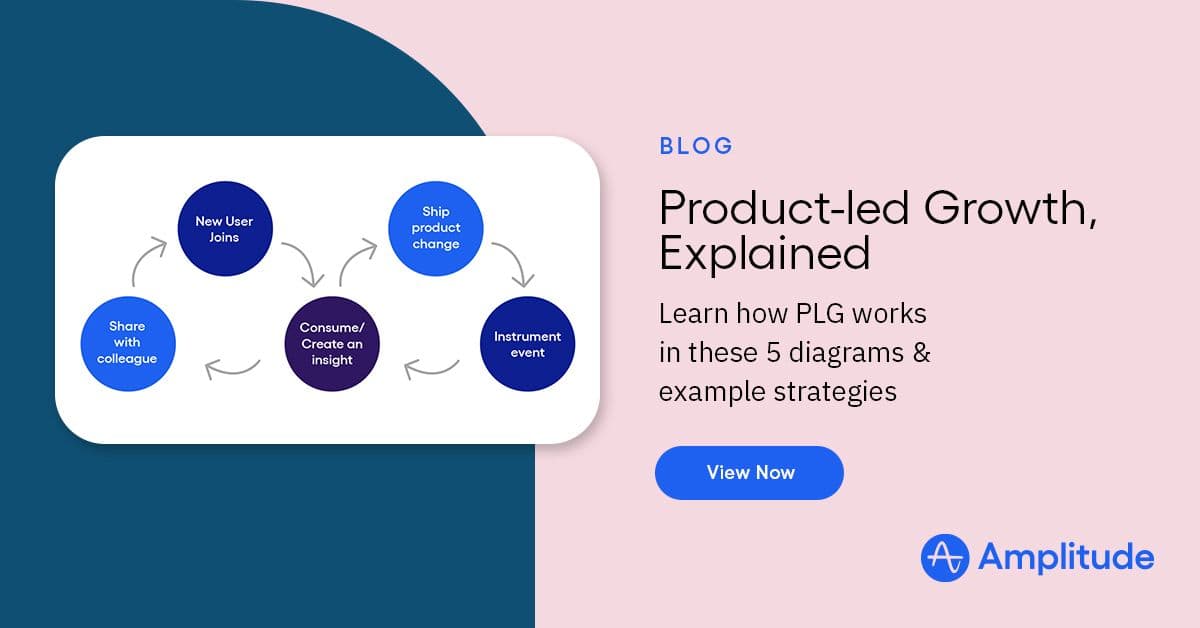
Learn more about product-led growth with these 5 PLG diagrams, or start mapping your product-led growth strategy with this free PLG worksheet.

Arpit Choudhury
Founder, astorik
Arpit is growing databeats (databeats.community), a B2B media company, whose mission is to beat the gap between data people and non-data people for good.
More from ArpitRecommended Reading

Your agent isn’t broken. It’s guessing.
Sep 23, 2026
6 min read

Bring headless Amplitude where you work
Sep 16, 2026
3 min read

Should I install the Amplitude SDK?
Sep 15, 2026
4 min read

Amplitude climbs to #3 in G2 Digital Analytics Momentum
Sep 15, 2026
10 min read
Explore Related Content
9 Top Feature Flag Solutions for Modern Product Teams in 2026
Jan 27, 2026
Using behavioral analytics for growth with the Amplitude app on HubSpot
Jun 17, 2024
10 min read
Identity resolution: The secret to a 360-degree customer view
Feb 16, 2024
10 min read
Inside warehouse-native Amplitude: A technical deep dive
Jun 27, 2023
15 min read
5 Proven Strategies to Boost Customer Engagement
Jul 12, 2023
Designing High-Impact Experiments
May 13, 2024
9 direct-to-consumer marketing tactics to accelerate ecommerce growth
Feb 20, 2024
10 min read
Leveraging analytics to achieve product-market fit
Jul 20, 2023
10 min read