How to Implement a Customer Journey Strategy that Works
A successful customer journey strategy starts with anticipating the potential paths a user may take when interacting with your product. Having a robust understanding of what the user experiences will help convert interest into loyalty.

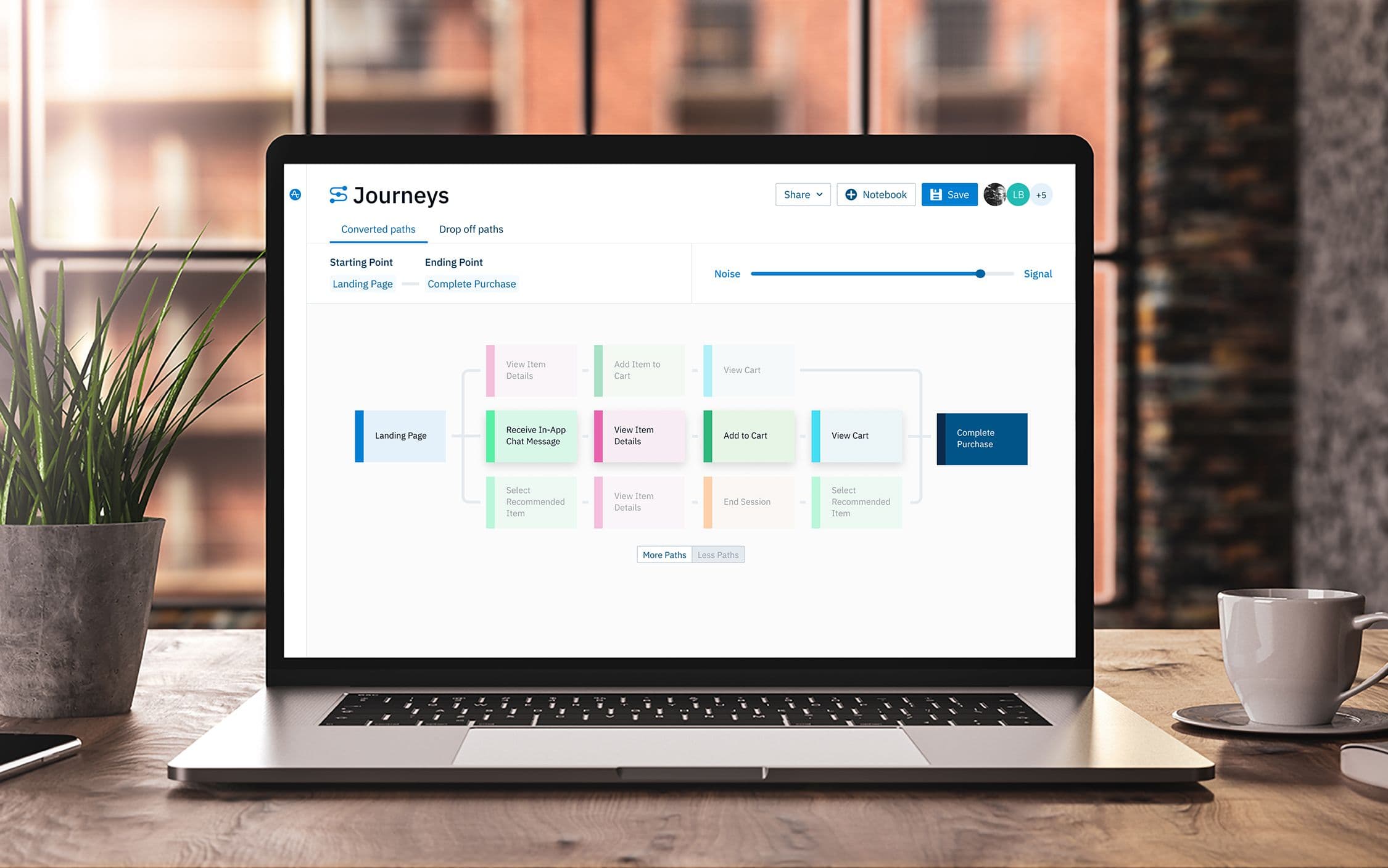
A customer journey represents the entirety of a customer’s experience with a company’s products and services, from their first interaction (discovering a company) to a milestone (the purchase and use of a product). It’s about more than a high conversion rate or good customer service. Instead, it’s about all of the interactions that a current or prospective customer might have with your company and product:
- How do potential customers discover your company?
- Once interested, is there an opportunity for prospects to participate in a free trial of your product?
- Once onboarded, do you offer continued support for current customers?
All of these interactions whether before, during or after are considered touchpoints in the customer journey.
When creating a customer journey strategy, you should have a robust understanding of what users experience as they discover your company and begin interacting with it. This can include their emotions, goals, challenges, as well as their background, along with any other factors that may impact their decision making. According to research by McKinsey, a customer-centric strategy can generate a 20-30% increase in customer satisfaction.
As for designing the customer journey, you should aim to make it as easy as possible for customers to understand your products and services. Even if your product is complex, teams should strive to make the journey simple. This means that marketing campaigns should also be targeted and segmented in order to meet your audience’s distinct needs. Before anything, you’ll want to invest time into developing a clear understanding of your customer, as doing so will help guide the rest of the customer journey.
Let’s take a look at what a good customer experience looks like, and more importantly, how analytics, surveys and other research can help create the customer journey strategy that underpins it.
Key Takeaways
- To create happy customers and advocates, you must understand current and prospective customers’ goals, emotions, needs and how they interact with your company and product at every step of the customer journey.
- Analytics can help a company to gain a deeper understanding of customer behaviors.
- Successful companies use various tools and machine learning to create personalized experiences for their customers.
- After a customer journey strategy is created, a company should continue to evolve and optimize it as new information about customer behavior becomes available.
Companies with Exceptional Customer Experience
Before we break down the step-by-step process of creating a strong customer journey marketing strategy, let’s look at three exemplary customer experience strategies by large, successful companies.
PayPal
In addition to having a well-designed, easy-to-use product, PayPal understands that an effective customer journey strategy is implemented by listening to customer feedback, and understanding what people are experiencing when they first interact with their product. Of course, statistics alone aren’t enough to guarantee success: a company must talk to their customers and actively reduce any causes of frustration. PayPal creates an outstanding customer experience by synthesizing all of this information.
Doordash
Doordash’s focus is on optimizing the food delivery customer experience, which they achieve by offering a highly personalized product. They use quantitative, qualitative and behavioral data to understand the customer journey and continually improve on it. Analyzing this data helps them to understand their customers, and it allows the company to enhance their overall customer experience through personalized interactions. Personalization makes a product easier to use, more rewarding, and adds to the overall positive experience a customer has with a company.
Amazon
There’s a reason the retail giant has become ubiquitous: the start-to-finish customer experience is both easy and convenient. Amazon’s product reviews, flexible shipping, easy returns and recommended products contribute to a shopping experience that helps to set them apart from their competitors.
For Amazon, success means they don’t rely on simple web analytics alone to determine customer behavior. They also employ advanced analytics tools and machine learning to predict what consumers want, enabling them to recommend items related to their unique customer profiles. Personalization is foundational in this strategy, as each user of their product receives an experience that is fully customized based on their browsing and shopping history.
How to implement a customer journey strategy
Note how the above companies all use analytics to understand their customers. They focus on their customers’ goals, emotions, and needs, in order to create an experience that leaves customers happy and satisfied. Companies that understand this and are willing to learn from what doesn’t work are going to be better at creating a customer journey that mitigates frustrations.
Let’s look at the six steps to implementing a customer journey strategy that works.
1. Understand what success looks like for your customer
Knowing what success looks like for your customers is a crucial first step in the process to building out your customer journey strategy. Customer success is defined as the process in which companies help customers achieve their goals through the use of their products or services.
Working with customers to understand their workstreams, challenges and goals will help in defining what success means to them, allowing you to help map out their path and ultimately determine what their customer journey strategy looks like.
2. Know the stages of the customer journey
Customers can go through multiple stages when it comes to the product journey lifecycle. These stages include:
- Awareness: This is the stage where a potential customer discovers your product for the first time. Your homepage, a search engine, an advertisement or a referral are all possible initial discovery tools.
- Consideration: Once a potential customer discovers your product, they’ll likely evaluate your offering against competitors to determine if there is a need. This could also be the stage at which a potential customer signs up for a free trial.
- Awareness/Purchase: When a need has been identified, the potential customer turns into an active customer by purchasing your product.
- Adoption: Once onboarded to your product, it’s important for a customer to begin using your product enough that it becomes part of their regular routine. If not used, the product loses its value and there’s a low likelihood of retaining that customer.
- Retention: To prevent churn, customers need to know that the goals they set are being achieved in order for them to renew the subscription.
- Expansion: While every customer’s needs are different, goals and challenges tend to change. This makes continuously checking in with customers key, as there may be an opportunity to include products that address their changing requirements.
- Advocacy: Happy customers can be your biggest brand advocates, so it’s important that you spend the time nurturing them throughout their customer journey.
3. Identify the various touchpoints of the customer journey
What are all the possible ways that people can interact with your company? To find out, leverage analytics to create a list that includes search engines, social media, advertisements, email content, sales, product demos and referrals. Also consider what’s behind all of these touchpoints: what motivates people to find your company? Determine what problem your product or service solves, and what the customer feeling was when they decided to look you up. Understanding the customer’s goals and motivations is important to building an ideal customer journey.
Touchpoints can be far-reaching, and customer service is only one part of the full customer journey. A company’s successful journey can also be generated by an immersive in-product experience or an engaging presence on social media.
4. Determine what actions customers will take
Are customers supposed to click a button to download a trial, contact you via phone or email, or take some other step? There should be a clear, simple path with a minimal number of steps. Offering too many options complicates the process and risks turning users away, while not enough options will create a barrier to entry.
On your website, in emails, social media, advertisements and other places, there should be clear steps for the user to take—a clear call-to-action that gives the customer the opportunity to take the next step. Remember that customer journeys are not linear. As there are a lot of actions a user can take, it’s important to take time to map out the full customer journey.
5. Increase retention by proactively reducing churn
Look at statistics, survey results and any other available information to understand why customers are not behaving as anticipated in the journey you’ve designed. For example, a lot of online retail companies have a high rate of customers abandoning their shopping carts on the last step before finishing the order. It would be helpful for them to understand why—perhaps shipping costs are a deterrent, or there’s a last-minute requirement to create a user profile.
Whatever it may be, you should aim to reduce all friction and pain points. The less frustrated your customers are, the greater the chance they turn into happy, loyal customers. This is where analytics and machine learning can intersect and help create personalized experiences for customers, reducing the obstacles between them and their goals. Additionally, checking in with customers along the way not just before and during the sale will help to proactively reduce churn and increase customer retention.
6. Continuously evolve your customer journey strategy
The online marketplace does not reward stagnation: review, update and refine your strategy. Your customer journey strategy should grow and evolve. New information and data obtained from analytics might result in a need for a new product launch or customer support may identify pain points current customers are experiencing with a certain feature. Continue to gather information about your customers needs and challenges, perform A/B tests, and update your customer journey strategy as needed.
A customer journey is not going to be linear and uniform, and neither should your customer journey strategy. But by being nimble, anticipating potential paths a user may take when interacting with your product and using analytics to dig into each stage of the journey, you’ll be well positioned to provide an experience that can convert interest into loyalty.
So if you’re looking for an answer to the user journey, no matter how simple or complex, Amplitude’s suite of resources can help your business increase its decision quality and velocity. You need a partner that can evolve and innovate with your teams, diving beneath superficial measurements and into the granular details that can separate you from your competitors in any industry or vertical.


Nikhil Gangaraju
Director, Product Marketing, Amplitude
Nikhil is a product marketer at Amplitude focusing on Amplitude Analytics and works with teams to advance our mission to help companies build better products.
More from Nikhil


