9 Best Pricing Strategies for SaaS Business Models
Discover which pricing strategies can deliver the greatest value for your product or service.

Browse by category
A pricing strategy is a process for how a company or business determines how to price its products or services.
If you’re assessing your SaaS pricing options, it’s important to consider the underlying business considerations that go into pricing, the different pricing strategies available to you, and the process for creating or customizing your pricing strategy.
Regardless of your specific pricing model, you need to avoid undercharging or overcharging. The former makes your business unsustainable and potentially devalues what you’ve built, while the latter will place limits on your growth.
Pricing affects both acquisition and retention, but it goes deeper than that. Once a customer is acquired, and you predict they’re not at risk of churning, could they experience even greater value? Could you capture more revenue from that product experience with a different bundle or tier? In this way, product iterations and pricing strategies are closely aligned.
Key takeaways
- Your pricing strategy is an important growth lever for your business. It should incorporate how your customers perceive or experience product value.
- SaaS pricing models fuel the adoption of agile methodologies and continually refined products.
- Reverse trials combine the best aspects of free trials and freemium pricing plans by simultaneously facilitating paid conversions and driving product usage.
- Inverse pricing personalizes the payment for users, with customers less likely to purchase given lower prices and larger discounts to encourage conversion.
- Usage-based, seat-based, and tiered pricing need to be evaluated through the lens of your product and its users. These pricing plans derive value from how often or how comprehensively your users engage with your product.
- Your customers are at the foundation of effective pricing strategies, and product analytics can help you better understand them. For example, identifying the most-used or highest-impact features for different groups of users allows you to see what matters to them and price accordingly.
Subscription pricing vs. standard pricing
- A subscription pricing model is when you bill customers in regular installments (e.g., monthly or annually) for a product or service.
- A standard pricing model involves a one-time payment for a product or service (pay as you go), where the relationship between vendor and consumer expires after product delivery or service completion.
SaaS and software pricing strategies
The nature of your product should majorly factor into whether you go with subscription pricing vs. standard pricing. A product regularly used by individual users or teams is a natural fit for SaaS (Software as a Service). The most common SaaS pricing model is subscription pricing because product value is continually experienced and paid for.
More importantly, subscription pricing allows product teams to adopt agile product management. They’re continually analyzing users and pushing out new features based on usage. By optimizing products and increasing subscriptions, SaaS companies are well-positioned for financial growth.
Another traditional benchmark to consider is competitor-based pricing. This can be a useful reference point if you’re a new entrant to your market and don’t have enough product usage data to inform your pricing strategies. At this nascent stage, competitor pricing can provide a useful reference point.
Penetration pricing is another valuable tactic for new businesses. The idea is to price low, then incrementally raise your pricing once you’ve established a reputation. However, this pricing model risks your customers believing your low-priced product is less valuable or lower quality, which may push them to a higher-priced, more reputable alternative.
9 different types of SaaS pricing strategies
Your journey toward finding the ideal pricing strategy for your product experience can be guided by product analytics tools, data-driven insights, and a culture of experimentation.
There are many types of SaaS pricing strategies, including:
- Free trial
- Freemium
- Reverse trial
- Inverse pricing
- Flat-rate pricing
- Usage-based pricing
- Seat-based pricing
- Tiered pricing
- Customized bundling or tiers
1. Free trial
A free trial is a common starter offering for many SaaS companies because it offers a preview of the full functionality a subscription would provide. Trials are typically limited by time or usage, with prompts to upgrade to the paid service at the end of the trial. An example is Adobe, which offers a 30-day free trial of its Creative Cloud products.
- Pros: With a free trial, users have minimal barriers to entry and receive a robust preview of the product’s functionality. This allows users to experience the full value of the product and build habits with paid features. Once the free trial is over and it’s time to upgrade, users are more likely to convert.
- Cons: Since trials are time-based (7-day, 14-day, month-long), organizations of varying sizes will have different experiences for the duration of the trial. Larger organizations might not be able to experiment with your product in the allotted trial period, whereas smaller teams might begin exploring its functionality immediately. Additionally, free trials mean your customer base is paid-only, so you lose the benefits that non-paying users can bring.
2. Freemium
A freemium model provides a basic version of the product or service free of cost, with the goal of users eventually opting into premium features or services. For example, the Spotify app allows free music streaming but with limitations like only being able to use the app in shuffle mode. The paid version removes these limitations.
- Pros: Freemium plans increase growth loops, or flywheels, as users experimenting with your product may attract other users through advocacy or word of mouth. You can also discover adjacent audiences you weren’t initially targeting and optimize your product accordingly.
- Cons: Users may be unaware of the value of your paid features since they are only experimenting within the limitations of the freemium plan. It can also be challenging to identify what features to offer in the free version, as not enough value could drive customers away, and too much could negate the need for payment.
3. Reverse trials
Reverse trials combine the appeal of freemium and free trials by enabling time-limited trial access to the premium features of a product before reverting to the limited freemium functionality. An example of a company using reverse trials is the project management tool Toggl, which offers full product use for 30 days. Users who don’t upgrade after that time revert to the limitations accompanying the freemium version.
- Pros: A reverse trial empowers users to experience the full value of your product instead of only a few select features. This removes the possibility that users will grow accustomed to free features without trying the full scope of your product’s capabilities. And since users have robust access from the beginning, it speeds up their familiarity, habit-building, and time-to-value within your product.
- Cons: If your product has a steep learning curve, users might reach the end of the trial before seeing the value of your product’s paid features. Users might also take advantage of the trial by signing up with multiple accounts.
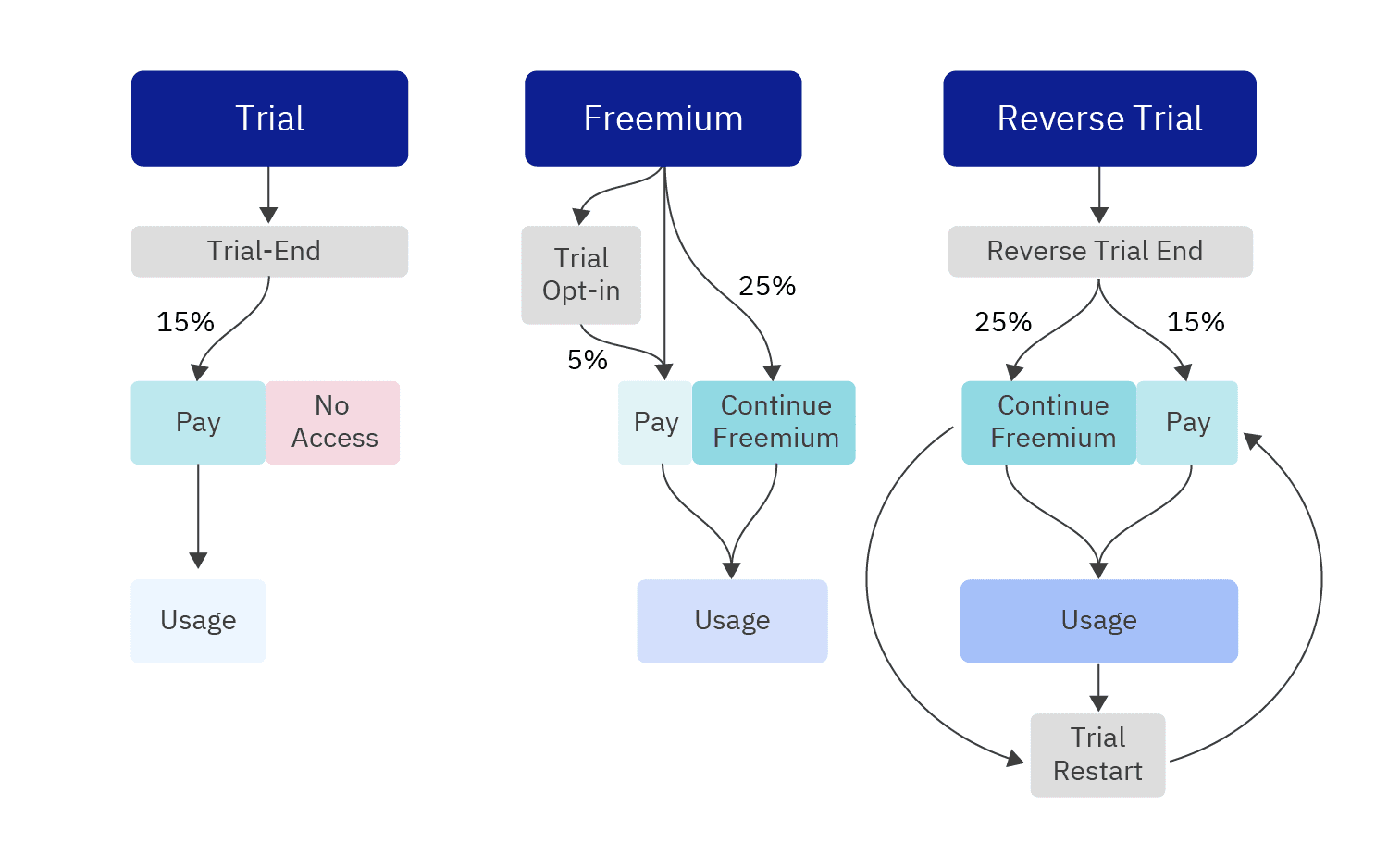
A side-by-side comparison of trial vs. freemium vs. reverse trial with typical conversion rates from Elena Verna
4. Inverse pricing
Inverse pricing models allow for some customization of pricing options for users in different groups (cohorts) based on their likelihood to upgrade. If a cohort is less likely to upgrade, you could offer them additional incentives. For example, a streaming service might offer users who aren’t likely to upgrade deals such as 20% off the subscription or the first few months free.
- Pros: This model allows for a level of personalization where a SaaS company can offer larger incentives to customers with a low likelihood to upgrade, whereas an email may be sufficient for users with a high likelihood to upgrade. This improves overall conversion rates.
- Cons: By rewarding users with a low likelihood to upgrade, you’re charging potential brand advocates more to use the same service. For products with an active community forum, this could lead to users feeling slighted.
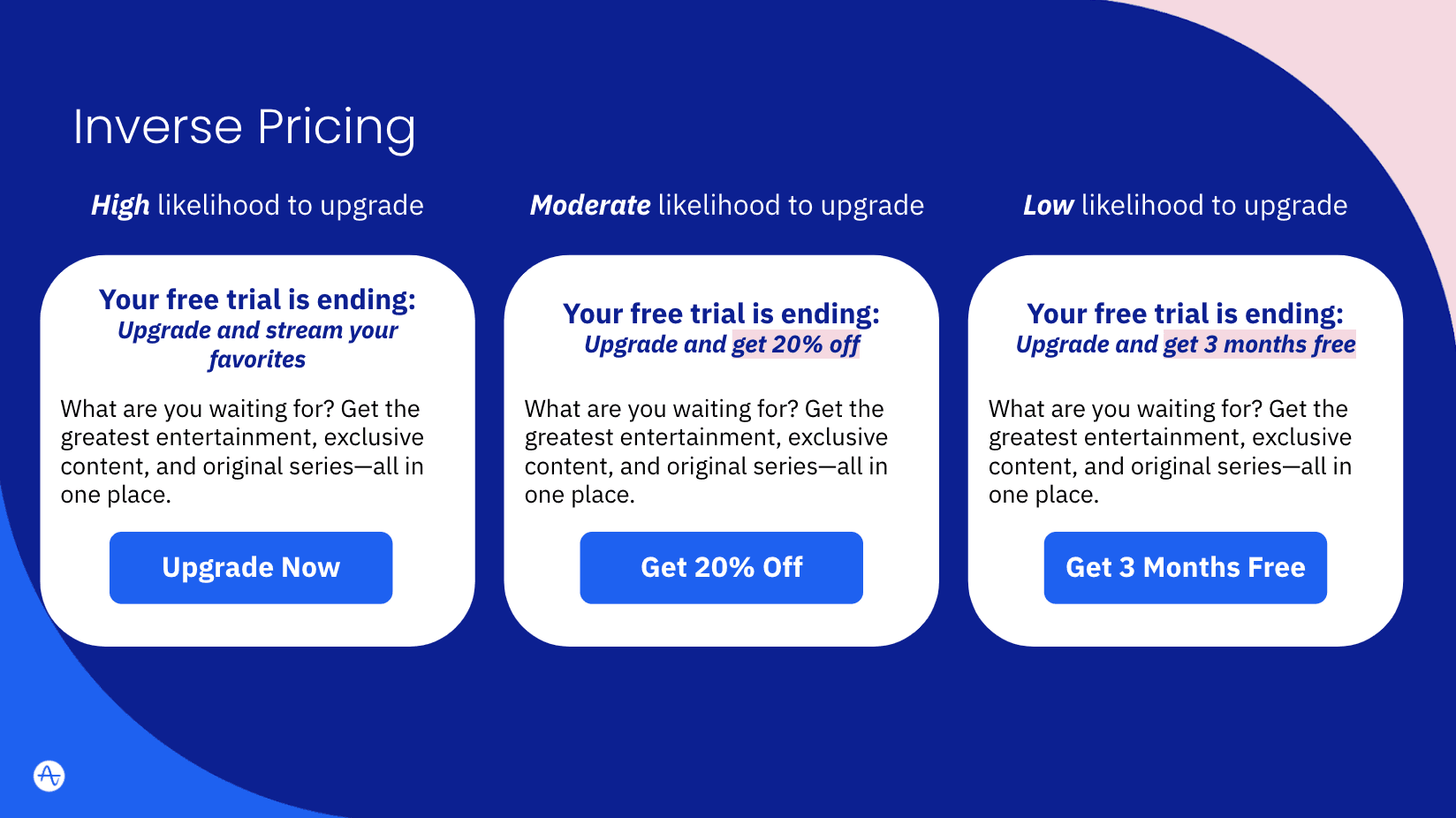
An example of inverse pricing for a streaming service
5. Flat-rate pricing
Flat-rate pricing is attractive for its simplicity because you can offer set features for a single price. But due to its inflexibility, flat-rate pricing is not common in the SaaS world.
- Pros: It’s a straightforward pricing plan because one price will unlock your product’s full functionality. Some customers may be unsure of what features they would find useful, so a flat-rate price would eliminate the need to choose.
- Cons: Its lack of flexibility means the strong possibility of alienating users who may only want specific features. It also doesn’t offer any wiggle room to entice hesitant customers into experimenting with your product. And you could leave significant revenue on the table from organizations that are able to pay more than the price you set.
6. Usage-based pricing
Usage-based pricing is the proportional version of SaaS—the more you use the service, the more you pay. It’s attractive to users and businesses as it ties usage with value, but you need to carefully determine your usage metric (e.g., event volume, feature usage, time spent using the product). Cloud-monitoring and analytics tool, DataDog, offers flexible usage-based pricing for teams looking to determine performance metrics or monitor events.
- Pros: It’s advantageous for consumers to have their billing tied to usage. There will be minimal payment in months when they don’t heavily use the service, and vice versa. There are also no prohibitive upfront charges that could scare off new users.
- Cons: This model makes it difficult for a business to forecast the revenue generated from a product or service. Similarly, a user could encounter challenges when an unexpected need for the service is at odds with their available finances.
7. Seat-based pricing
Seat-based pricing is optimal when the size of a customer’s team is a good indicator of the value they’re receiving from the product. As the team collaborates, more users having access translates to more value—and a higher price point. Seat-based pricing can apply to all users or only active users. An example of seat-based pricing is the Microsoft Office suite, which charges a monthly fee based on the number of users.
- Pros: Acquiring customers is simplified, as the initial cost for the product is lower, and new customers can acquire additional team members when they need to collaborate. It’s also an intuitive pricing model because teams will only pay for dedicated users.
- Cons: It’s difficult to monitor license sharing between users, which can lead to lost revenue for a business. There’s also the challenge of increasing product usage internally because each new user will have to pay for a seat.
8. Tiered pricing
Tiered pricing reflects the increasing bundles of value that go along with increased prices. Starter tiers limit user seats, actions, or advanced functionality, whereas higher tiers unlock additional features, advanced support, and guaranteed service-level agreements. Typically, users can switch between monthly and yearly pricing and receive better value if they’re locked into a year. Drift, a revenue acceleration platform, uses tiered pricing to unlock increasing value across the Premium, Advanced, and Enterprise packages.
- Pros: Tiered pricing resolves one of the cons of the freemium model, where initial entry is still billable, and additional features could become desirable once users familiarize themselves with the product. It also appeals to products that target businesses of varying sizes and needs.
- Cons: Finding the right feature mix for each tier is challenging. It can be difficult to convince users of the value they’ll unlock in higher tiers if they don’t believe the new features are worth the price increase. Higher-tier users can also demand more from your support resources as they navigate complex features.
9. Customized bundling
Customized bundling combines different products or features to create a new product, which is then sold to a customer at a single price. For example, Amazon Prime includes its streaming package in its subscription to bring visibility to the offering.
- Pros: Bundles present the opportunity to highlight new or underused features or products by combining them with more popular offerings. If a certain feature is not available outside the bundle, a customer could be motivated to spend more than they anticipated in order to use it.
- Cons: Some users may not see the value in the additional features in a bundle, and if those features aren’t available individually, you risk losing their business. It can also lead to lost revenue for your company, as the two (or more) features or products will be sold together at a lower price point than if they were each priced separately.
How to create a pricing strategy
Still unsure where to begin? Reverse-engineer pricing from the needs of different buyer personas or cohorts, and factor that in alongside your business finances and growth goals. Ultimately, pricing strategies reflect an understanding of your customers and how they perceive pain points and value.
Solid, trustworthy data about user behavior will always be better than hypothesizing based on instinct. Different segments may not behave as you expect, or they may match your expectations—but for different reasons than you thought. Analytics can help product teams identify the highest-impact features and prioritize feature requests, which you can use to inform and support different pricing tiers.
For example, measuring feature engagement using Amplitude’s engagement matrix might show that a relatively small group of users access a particular feature but with high frequency. This could inspire a differently bundled package or customized pricing, as well as product iterations that expand the awareness and relevance of those features.
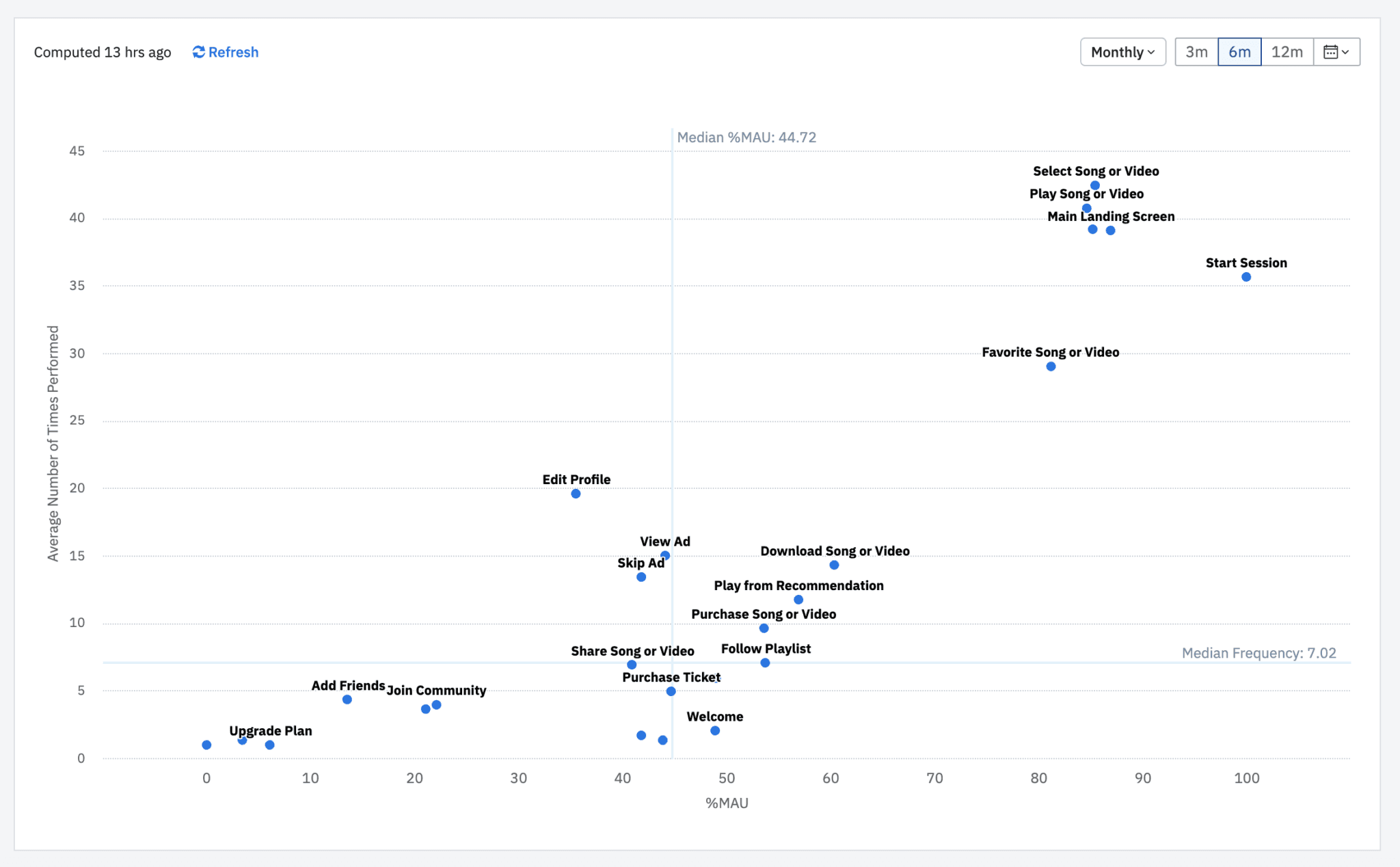
An example engagement matrix, where the top-right quadrant shows actions performed with high frequency by a high number of users
Predictive analytics can also inform your pricing strategy. Using Amplitude’s Predictions, you can predict customer behavior and answer pricing questions like:
- Which customers are likely to convert at this price?
- At what price will customers abandon their shopping carts?
- What marketing promotions or discount offers will customers use?
- Which features are customers willing to pay more for?
A customer-centric approach to your pricing strategy
As you begin crafting or adjusting your pricing strategy, remember to keep the customer in mind at every step. Not only will this be critical in developing a pricing model that attracts customers, but it will also help you attain sustainable revenue growth from those customers in the long run.
Optimizing your pricing to better serve customer needs should be driven by data since analytics will help you understand customer behavior at different price points. If you’re ready to connect product analytics with your pricing strategies, get started for free with Amplitude’s starter plan.
Additional resources to inform your SaaS strategy
- How to Calculate & Interpret SaaS LTV
- How to Perform a SaaS Cohort Analysis to Reduce Churn
- How to Create a SaaS Go-To-Market Strategy

Noorisingh Saini
Global Content Marketing Manager, Amplitude
Noorisingh Saini is a data-driven marketer managing global content marketing at Amplitude. Previously, she managed all customer identity content at Okta. Noorisingh graduated from Yale University with a degree in Cognitive Science.
More from Noorisingh


