What Is A Product Strategy? Framework, Template, and Examples
Build products that align with your vision using a well-defined product strategy.


Originally published on April 18, 2022
Browse by Category
A product strategy is a plan to define your product's vision and identify how you will realize that vision. It’s built with the “big picture” of your product in mind, helping you justify your product’s existence and how users can benefit from it. A well-tuned product strategy ensures that everyone is working in sync toward the same high-level business goals.
Your product strategy prioritizes your product’s most critical aspects, such as features and timetables, throughout development. It keeps your organization’s collective product management efforts focused on customer needs, market positioning, and overarching business goals. This focus on value enables your team to launch products, ensuring that every feature aligns with your original vision.
key takeaways
- A product strategy defines why your product exists, who it benefits, and how your company plans to develop it.
- A product strategy framework is one of the critical elements of a successful strategy. It helps you diagnose problems and envision solutions.
- You can use several different product strategy models, including differentiation, quality, cost, and focus models.
What is product strategy?
A product strategy bridges the gap between conceptualizing your product and creating your development plan. You might have a terrific idea, but jumping straight from product dream to reality can be challenging.
A product strategy outlines your product’s purpose and the work required to bring it to life successfully. It helps you answer three essential questions about your product:
- Who is your customer base?
- How will your product address these customers’ pain points?
- How will your product benefit the company?
The answers to these questions will inform your product's broad-stroke planning. These big-picture strategies include your product's features, a general blueprint for product development, and the measurable objectives your company hopes to achieve.
People often confuse product strategies and roadmaps, but they serve distinct purposes. A roadmap is a timeline of action items that outline how your product will come together. A successful roadmap establishes your vision and timelines and ties to the goals established in your product strategy.
Your product strategy is a reference point as your product roadmap changes throughout development. Deadlines, tasks, and goals are all bound to shift or change during product development in response to feedback, testing, and unexpected obstacles. Adhering to a set product strategy enables you to handle changes and devise solutions aligning with your product’s vision.
The importance of product strategy to your business
A product strategy helps you align your product’s trajectory with customer and internal expectations. It’s so important that 76% of product professionals say that investing in product strategy is one of the most essential investments a team can make.
A quality product strategy:
- Defines your product’s niche: A well-researched product strategy gives you a clear sense of your product's niche when it goes to market. This awareness enables your teams to make decisions during development that speak to this niche and, thus, to your intended audience.
- Informs your product roadmap: Your product roadmap acts as the official game plan for developing, releasing, and growing your product. It’s your company’s ultimate task management resource and helps ensure your team meets deadlines. Hiccups in the development process may change action items on the roadmap, but those changes are visible to and respected by all parties involved.
- Provides direction and clarity for internal teams: Everyone within your company works to bolster the success of your product. Your product strategy helps ensure everyone, not just your product team, is in sync with your goals.
Though every team within your organization undoubtedly supports your product, they likely will have differing views on the best way to get there. When faced with uncertainty or disagreement, your teams can refer to your product strategy. Leaders can compare potential decisions against your product strategy to determine which proposal best suits your product's intent.
How to build a successful product strategy framework
A clear, well-documented product strategy framework facilitates transparency for every employee tasked with building, selling, and supporting your product-to-be. When you set your product strategy in stone, you create a resource for stakeholders to reference at every stage of development. It also helps keep your product and company vision at the heart of every decision your team makes for your product.
The basic framework for an effective product strategy looks the same whether you’re building an ecommerce site or a crypto trading app. Product strategy frameworks typically include the following steps:
- Evaluate your current state: What does your product do now? What are its strengths and weaknesses? Knowing your current position helps you clarify which aspects of your product are relevant for customers and where there’s room for improvement. This evaluation is about understanding your product's functionality in depth. How does each feature serve your customers, and how can these functionalities be enhanced?
- Define your product vision: What would you like your product to do, and why? A comprehensive product vision gives you and your team a clear, long-term goal to work toward. Your vision statement guides decision making and can inspire your team. It helps you align development efforts with broader objectives so you can solve real-world problems and address specific customer needs.
- Identify your target audience and their pain points: Whose problems are you solving? Tailor your product to meet the specific needs of your target customers. This approach enables you to craft a unique value proposition, relevant messaging, and effective marketing strategies that clearly show how your product solves customers’ problems.
- Perform competitor research: How will you differentiate your product from what’s already there? Conducting thorough market research helps you understand what’s missing from the market that your product can address. It enables you to position your product uniquely, highlighting features and benefits that set it apart.
- Analyze market trends: How well are existing options performing? What market changes should you anticipate? Understanding these trends is essential for navigating your product lifecycle, from introduction to growth to maturity.
- Set quantifiable goals: What does success look like? How will you define it? The best goals are ambitious yet achievable, helping you gauge the effectiveness of your product strategy over time. Tie them to specific performance indicators, such as customer engagement or conversion rates, to objectively measure the success of your product strategy and its execution.
- Create your product roadmap: How will you get there? A detailed product roadmap outlines the steps needed to achieve your product vision. Your roadmap is a strategic document that aligns your team’s work with your overall business objectives so all stakeholders understand the priorities and timelines.
- Prioritize your initial actions: What steps ensure a successful start? Determining the most critical actions to take at the outset helps your team focus on high-impact activities that drive your product forward. Early wins build momentum and confidence among your team and stakeholders.
- Set guidelines for evaluating your product strategy: As time passes, is your product development still aligned with your initial strategy? Regularly review your product strategy against actual progress so you can adjust your approach as needed.
Using a product strategy template makes it easier to define your product strategy. Amplitude’s three-step product strategy template can help you jumpstart your efforts, using insights from your data to inform your product strategy and providing resources related to:
- Delighting your customers
- Planning for growth
- Differentiating your product from the competition
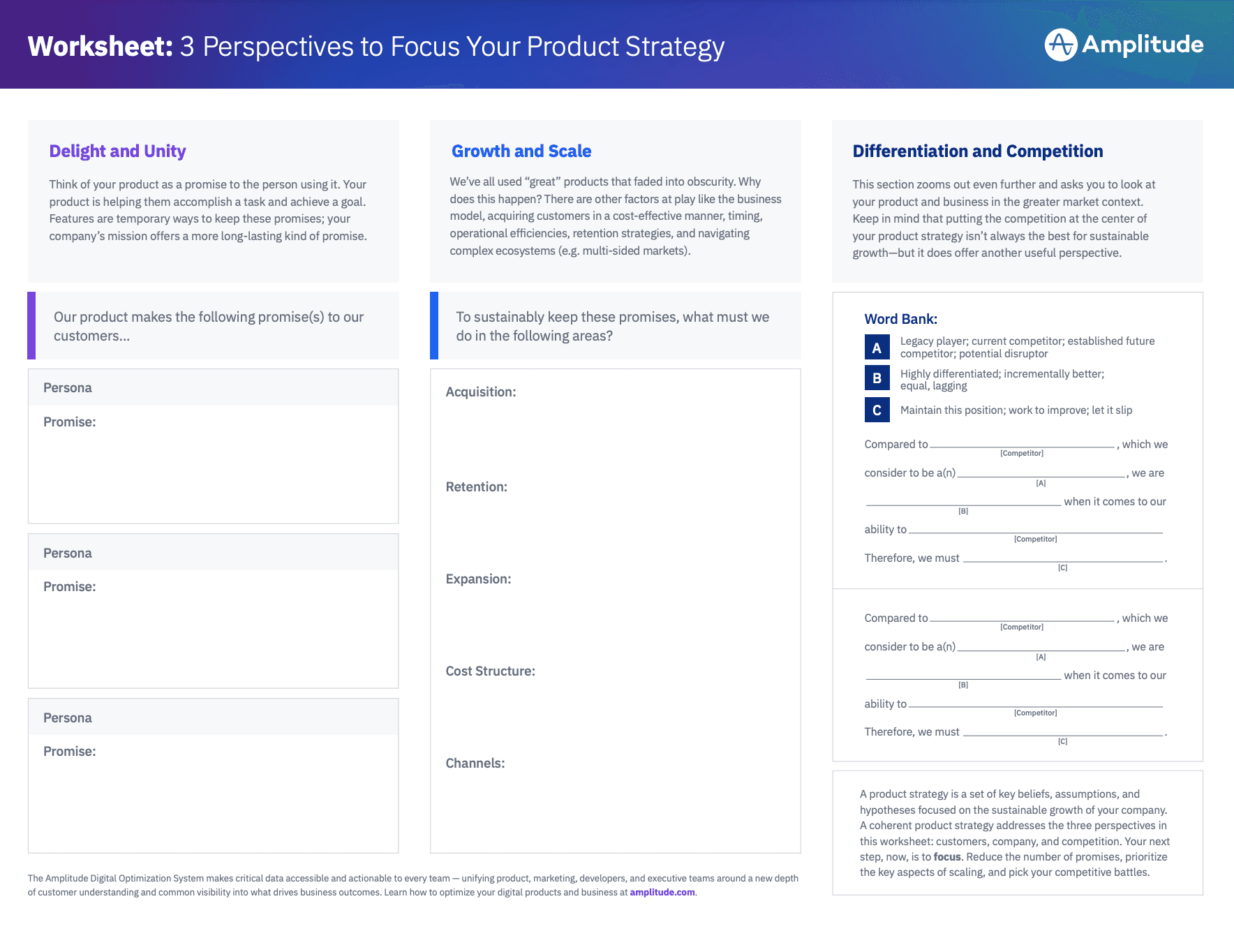
Download the product strategy template to start creating your strategy.
Three critical elements of a successful product strategy
The details of your final strategy will look different from every other business because your company’s values and objectives are unique. However, nearly every product strategy encompasses these elements:
1. Identifying your audience
Conducting audience research before crafting your product strategy ensures you have an audience for which to build a product. Research will also identify existing competitors and help you determine how to position your product against them.
Through diligent research, you can uncover deep insights into customer needs and preferences, paving the way for products that make a difference to users. This proactive approach ensures a ready market at launch and enhances your positioning by aligning product features with well-researched customer pain points.
2. Embracing your data
At the heart of product strategy is a single question—“What are customers looking for in a product?”—and your product data is the key to answering it. Behavioral analytics will reveal the product features from your existing offerings that provide the most customer value. These insights give you a frame of reference for defining your new product, user base, and initiatives.
Leading companies find that data-informed product strategies are crucial to success, but many businesses struggle to achieve data democracy. Data is often siloed within departments, limiting visibility to valuable marketing, sales, or product insights across teams. Since every team in your company will adopt your product strategy, using a unified data management system like Amplitude helps ensure maximum data accessibility.
3. Establishing goals
You can’t solve a customer’s problems with a hypothetical product. Goal setting establishes a timetable for developing your product and synchronizes expectations for delivery across teams. Start with long-term goals for your product, like the official date for product launch. Once you establish these big-picture goals, you can divide the timetable into shorter phases to create more focused goals and expectations.
Goals are only helpful if they’re measurable. As such, ensure you have a way to gather metrics and data to determine your progress toward each goal. For example, a goal for your music streaming service may be to have a million active users by the end of your first year. A digital analytics platform like Amplitude would help you track your users from their first visit to your website through the user onboarding process and beyond.
An example of Amplitude’s pathfinder chart. Try it yourself for free.
Standard metrics and KPIs used by companies to measure product strategy goals include:
- Customer acquisition cost (CAC)
- Customer lifetime value (CLV)
- Monthly recurring revenue (MRR)
- Monthly usage
- Retention rate
Effective product strategy models
No single product strategy fits every company’s goals, products, and target markets. Some examples include:
Differentiation strategy
This product strategy model works best for products that are unique and different from existing offerings on the market. It attracts customers with unique features or capabilities they didn’t know they were missing. The cell phone industry has long been a battleground for companies touting everything from wireless charging to bendable screens to differentiate themselves from competitors.
The key to a differentiation strategy is to develop a product that stands out, and there are multiple ways to do so:
- Developing an entirely new feature: Identifying and developing unique product features is critical to setting your offering apart in a crowded marketplace. It appeals to customers because your product is the only one in the market with that feature.
- Including as many related features as possible: Providing a comprehensive product experience saves customers from purchasing multiple digital solutions.
- Focusing on usability: Existing products can sometimes be unwieldy, overly technical, and not particularly friendly for beginner users. Some companies approach their products as the “easiest” way to get desired results.
Quality strategy
Another approach to product strategy is to create the best possible product in terms of reliability, capabilities, and experience. A quality strategy positions your product as the premium option against inferior competition. Apple enthusiasts continue to buy their devices because they’re accustomed to the high-end aesthetics, operating system (OS), and digital ecosystem the company offers with remarkable consistency.
Products built with quality in mind can’t afford to focus on pricing. Hiring the brightest minds and creating the best products will take money and resources, which are reflected in the product’s final pricing point.
A company like Lamborghini doesn’t compromise the quality of its cars to appeal to a lower pricing point, which only makes the product even more desirable despite its hefty price tags.
Cost strategy
The cost strategy focuses on making a valuable yet inexpensive product. Products in this category are cost-effectively built to go to market at a lower price than competitors. This strategy works best when your new product isn’t differentiated from existing offerings through new features, UI/UX improvements, or other value-centric aspects.
For example, a company making plastic forks would prioritize making the highest volume of functional forks for as little cost as possible. Customers are unlikely to pay attention to the aesthetics or brand of their forks so long as they work.
Cost strategy works best if your improvements target the development process. The cheaper it is for you to develop a competitive product, the lower you can price your product while still remaining profitable. However, a pricing race to be the bottom often elicits bias from skeptical customers. Many believe an inexpensive product can’t be high quality and will pay more for something they believe to be of higher value.
Focus strategy
This popular approach to product strategy focuses on building a product to appeal to a hyper-specific market. Focus strategy enables companies to dedicate their resources to developing features for a well-defined segment. The result is a product that performs exceptionally within a niche market instead of underwhelming a broader market with just a little bit of everything for everyone.
Examples of potential product niches include:
- A particular demographic: Your product could target users within a certain age bracket, vertical, or gender.
- A specific geographic area: Sometimes, regionality is at the core of a product’s appeal. If you develop a product specifically designed to assist house flippers in Omaha, you’ll want to keep your focus on users from Omaha.
- A unique persona: Your product might appeal to like-minded users who don’t fit neatly into demographic or geographic boxes. For instance, a persona-focused strategy would be the choice for a product aimed at tech founders or one built as a resource for new parents.
Focus strategy narrows your field of competition and enables you to satisfy the specific needs of a small group.
Consider this: 10% of people are left-handed. However, for most of human history, scissors have been made exclusively for right-handed users. The company that released Lefty Scissors in 1967 went from competing for the whole market to owning 10% of it by focusing on the needs of a single group.
Product strategy over the product development lifecycle
Your product strategy is meant to provide stability to your product development process. Constantly changing your strategy undermines its ability to provide consistent guidelines and expectations for your teams over the course of development.
Take time in the initial planning stages to ideate and revise your strategy so that your long-term vision holds up across the product development lifecycle.
That’s not to say that you should never evaluate your product strategy. Quick and routine assessments of how your current product roadmap aligns with your product strategy provide opportunities to identify and correct “strategy drift.”
Additionally, product strategy is an iterative process. Once your most recent product plan has run its course, evaluate your latest strategy. Careful analysis will reveal what worked and what didn’t, helping you build even more effective strategies and products in the future.
References
Thinking through your next product strategy? Leverage product strategy worksheets from The Product Strategy Playbook: A Guide to Flywheels and make sure you’re measuring the right goals by following the North Star Playbook.


Christopher Selden
Former Principal Product Manager, Data Connections, Amplitude
Christopher Selden is a former principal product manager at Amplitude, driving development for data products such as Amplitude's data warehouse and cloud storage products, as well as their integration infrastructure. He previously worked as a product manager focusing on data management and new products at Samsung and Criteo.
More from Christopher


