How to Benchmark Product-led Growth with OpenView Partners Blake Bartlett and Kyle Poyar
Learn how to lead the market with five pillars of product-led growth and their benchmarks.

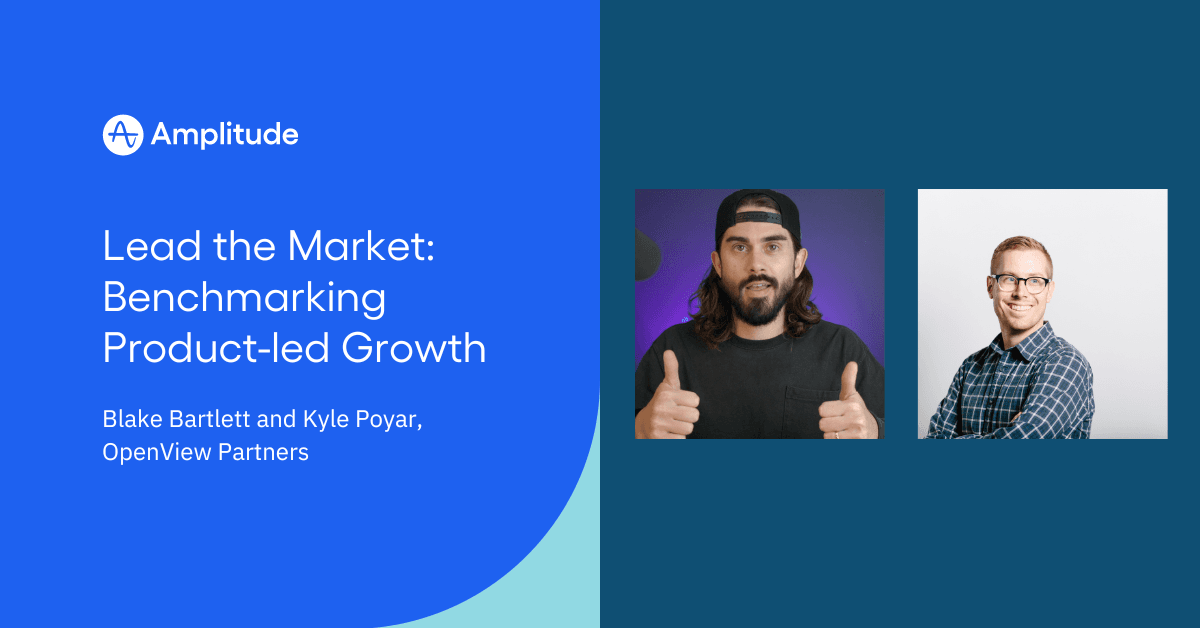
Product-led growth (PLG) is an industry buzzword often thrown around by product and marketing teams. But how do you actually define product-led growth and measure your PLG motion? At Amplify 2022, we invited the original thought-leader that coined the phrase, Blake Bartlett, along with his partner at OpenView, Kyle Poyar, to shed some light on Benchmarking Product-led Growth.
The rise of the end user era
PLG was born out of a major shift in how software is adopted today. Bartlett shares how adopting new software used to be a laborious process that involved a lot of people, a lot of time, and, frankly, a lot of eye-rolling from users.
Previously, executives would tell their team what software to use, and users would have no choice in the matter. Now, end users find and adopt that software on their own, then ask their boss to pay for it.
Learn more about the shift from the executive era to the end user era in Bartlett’s blog post.
How do organizations adapt to this shift? You guessed it—PLG. According to Bartlett, “As opposed to human effort from your sales and marketing team alone… the primary driver of your go-to-market motion becomes the product itself.”
How do you benchmark for PLG? Bartlett and Poyar identify five core pillars of PLG that will help organizations embrace the end user era:
- Build for the end user
- Distribute with user discovery in mind
- Create a frictionless onboarding experience
- Show value before asking users for money
- Sales teams help with expansion, not demand
More information on each of these pillars and how to benchmark them can be found in OpenView’s Product-led Growth blog post and OpenView’s 2022 Product Benchmarks report, respectively.
1. Build for the end user
Organizations should be specific about the persona they’re building the product for. “There’s no such thing as a generic user,” Bartlett states. “Identify the person you’re building for. Is it the actual user of the product, or is it the executive that runs that department?”
Conversion benchmark: Website visitor to free account signup
How do you know if you’ve successfully built a product that solves user pain? According to Poyar, the conversion metric PLG companies should focus on is the percentage of website visitors creating a free account. “If you’re solving for a strong enough user pain, folks will be willing to go through the hassle of giving you their email because they want to jump into the product and see if it actually works for them,” says Poyar.
2. Distribute with user discovery in mind
PLG centers around consumer empathy and understanding. Once you’ve built a product that solves the end users’ pain points, meeting them where they’re at for distribution is essential.
Distribution benchmark: Share of new signups from different sources
Because distribution for PLG companies is all about discovery, Poyar suggests the metric you should look at is where your new user signups are coming from.
Don’t rely on traditional paid channels
OpenView’s 2022 Product Benchmarks report shows that standout PLG and freemium PLG companies don’t get much acquisition from paid ads and outbound sales. “It just doesn’t work with how users find and want to buy products,” says Poyar. “The times when these channels do come into play are around testing. For instance, testing new messaging or running campaigns to new audiences. They’re not the core way of attracting an audience.”
Note: All images used throughout this blog post are provided by Blake Bartlett and Kyle Poyar. This data can be found in the OpenView 2022 Product Benchmarks report.
Where should PLG companies invest instead? Bartlett and Poyar share three ways companies have successfully approached discovery.
1. Virality, collaboration, and product invites
The easiest way to sell a product is to have it sell itself. Bartlett shares that companies with a viral loop or collaboration hook should capitalize on it as a distribution channel.
One example Bartlett shares is Calendly, a scheduling tool that needs to be shared with others. “You can’t schedule a meeting with yourself, right?” asks Bartlett. “So, if you’re using Calendly and sending that link around, by definition, you’re also helping to promote the product as well.”
Figma and Slack are similar examples in that they lean on collaboration and network effects.
While product invitations aren’t as essential in the early stages of a company, Poyar says they quickly gain importance as companies scale.
2. Organic product-specific SEO
If you don’t have virality in your product, optimizing your website for organic search results is another way to acquire users.
Poyar shares how Zapier scaled its product discovery through SEO by creating landing pages for every product use case, workflow, and app integration. Zapier also provides a seamless signup experience on these landing pages, so users can immediately try the product and experience value.
3. Social media channels
While traditional paid channels don’t help PLG companies acquire new users, social media might be the exception to that. According to Poyar, PLG companies are increasingly leaning into paid Instagram and Tik Tok ads, as well as paid influencer posts. “This is an opportunity for PLG companies to really stand out and outcompete their traditional peers,” says Poyar.
3. Create a frictionless onboarding experience
End users don’t have the patience for traditional sales cycle friction. They demand self-service solutions they can access immediately, such as automated onboarding with social login.
Onboarding benchmark: Activation rate
You should track product activation to measure how you’re meeting your audiences’ needs when they get started. According to Poyar, “Product activation really just means that you’re solving the problem for a user that brought them to your product in the first place… They get to their aha moment. These activation metrics are going to be different for every product, depending on what your product does.”
OpenView’s 2022 Product Benchmarks report found that only 20–30% of new users reach activation at standout PLG companies. Thus, it’s essential to continually test and tweak onboarding flows to reduce time to value for users (as indicated by activation rates). Poyar urges listeners to start tracking activation—if they don’t already—as it’s fundamental to PLG.
4. Show value before asking users for money
At the end of the day, your company has to generate revenue. But when and how you choose to make the user pay for your service is a crucial decision. “You’re gonna want to deliver value first before users hit the paywall,” says Bartlett.
Barlett shares his own experience as a loyal, long-time user of Spotify. He initially started with the freemium version and didn’t move to a paid membership until he experienced the platform’s value over time (creating playlists, discovering new music, etc.).
Value benchmark: Free to paid conversion
Free to paid conversion rates signal whether your product is providing enough value for users to make the switch. Based on OpenView’s 2022 Product Benchmarks report, companies with free trials typically see higher conversion rates than those with freemium experiences. But Poyar notes that freemium companies typically have more website signups and virality through product invites. “If your product increases in value the longer someone uses it,” says Poyar, “freemium tends to be a good option.”
Poyar also reminds listeners that freemium access and a free trial are not exclusive. In fact, some of the most successful companies use a combination. Starting with a free trial showcases the value of the product—including features prospects may not even know they want yet—before switching to a freemium version. “Once you’re using these features, you don’t want them taken away from you,” says Poyar. “It drives the urgency and feature discovery of a free trial business, while still allowing you to engage that long tail of users who need a little bit more time, like a freemium business does.”
Poyar encourages businesses to consider which combination or single model will work best for their specific product.
5. Sales teams help with expansion, not demand
Traditionally, companies hire their sales team first, but with PLG companies, the inverse is true. Sales is really more about customer expansion—taking contracts to the next level—rather than soliciting users. PLG companies hire as demand builds, rather than hiring to build demand. Bartlett describes the build-up for PLG companies in the following way:
- Got users? → Hire Support
- Got Teams? → Hire Success
- Got Departments? → Hire Sales
An example of this model that Poyar shares is Zoom, which reported that 55% of its customers that currently spend $100K started as one free user.
Sales benchmark: Product-qualified leads
By hiring sales last, PLG companies are able to use product data to evaluate accounts for Product-Qualified Leads (PQLs). Companies can start using customer data in really simple ways to start uncovering PQLs: “As soon as you hit five users in the same account,” says Poyar, “maybe the sales rep gets notified, and you have a course of action that they should take, and then build more PQLs from there.”
In this way, sales teams don’t waste their time calling random leads, but only the ones that are shown to be qualified. “They’re actually able to improve the sales process and drive better conversion rates and a better customer experience,” says Poyar.
PLG is the future of business
According to OpenView’s 2022 Product Benchmarks report, PLG companies are growing faster and showing 80% higher revenue multipliers than traditional companies.
As Poyar so aptly put it, “The end user era is here. PLG is how you adapt.” With the core pillars of PLG and the corresponding benchmark metrics in your back pocket, the sky’s the limit. Want to learn more about PLG? Check out the full session and other data, marketing, and product talks from Amplify 2022.

Noorisingh Saini
Global Content Marketing Manager, Amplitude
Noorisingh Saini is a data-driven marketer managing global content marketing at Amplitude. Previously, she managed all customer identity content at Okta. Noorisingh graduated from Yale University with a degree in Cognitive Science.
More from Noorisingh


