Platform

AI

AI Agents
Sense, decide, and act faster than ever before
AI Visibility
See how your brand shows up in AI search
AI Feedback
Distill what your customers say they want
Amplitude MCP
Insights from the comfort of your favorite AI tool

Insights

Product Analytics
Understand the full user journey
Marketing Analytics
Get the metrics you need with one line of code
Session Replay
Visualize sessions based on events in your product
Heatmaps
Visualize clicks, scrolls, and engagement

Action

Guides and Surveys
Guide your users and collect feedback
Feature Experimentation
Innovate with personalized product experiences
Web Experimentation
Drive conversion with A/B testing powered by data
Feature Management
Build fast, target easily, and learn as you ship
Activation
Unite data across teams

Data

Warehouse-native Amplitude
Unlock insights from your data warehouse
Data Governance
Complete data you can trust
Security & Privacy
Keep your data secure and compliant
Integrations
Connect Amplitude to hundreds of partners
Solutions
Solutions that drive business results
Deliver customer value and drive business outcomes
Amplitude Solutions →

Industry

Financial Services
Personalize the banking experience
B2B
Maximize product adoption
Media
Identify impactful content
Healthcare
Simplify the digital healthcare experience
Ecommerce
Optimize for transactions

Use Case

Acquisition
Get users hooked from day one
Retention
Understand your customers like no one else
Monetization
Turn behavior into business

Team

Product
Fuel faster growth
Data
Make trusted data accessible
Engineering
Ship faster, learn more
Marketing
Build customers for life
Executive
Power decisions, shape the future

Size

Startups
Free analytics tools for startups
Enterprise
Advanced analytics for scaling businesses
Resources

Learn

Blog
Thought leadership from industry experts
Resource Library
Expertise to guide your growth
Compare
See how we stack up against the competition
Glossary
Learn about analytics, product, and technical terms
Explore Hub
Detailed guides on product and web analytics

Connect

Community
Connect with peers in product analytics
Events
Register for live or virtual events
Customers
Discover why customers love Amplitude
Partners
Accelerate business value through our ecosystem

Support & Services

Customer Help Center
All support resources in one place: policies, customer portal, and request forms
Developer Hub
Integrate and instrument Amplitude
Academy & Training
Become an Amplitude pro
Professional Services
Drive business success with expert guidance and support
Product Updates
See what's new from Amplitude

Tools

Benchmarks
Understand how your product compares
Templates
Kickstart your analysis with custom dashboard templates
Tracking Guides
Learn how to track events and metrics with Amplitude
Maturity Model
Learn more about our digital experience maturity model
Pricing
LoginContact salesGet started

AI

AI AgentsAI VisibilityAI FeedbackAmplitude MCP

Insights

Product AnalyticsMarketing AnalyticsSession ReplayHeatmaps

Action

Guides and SurveysFeature ExperimentationWeb ExperimentationFeature ManagementActivation

Data

Warehouse-native AmplitudeData GovernanceSecurity & PrivacyIntegrations
Amplitude Solutions →

Industry

Financial ServicesB2BMediaHealthcareEcommerce

Use Case

AcquisitionRetentionMonetization

Team

ProductDataEngineeringMarketingExecutive

Size

StartupsEnterprise

Learn

BlogResource LibraryCompareGlossaryExplore Hub

Connect

CommunityEventsCustomersPartners

Support & Services

Customer Help CenterDeveloper HubAcademy & TrainingProfessional ServicesProduct Updates

Tools

BenchmarksTemplatesTracking GuidesMaturity Model
LoginSign Up

How to Choose the Right Tracking Plan Template

Tracking plan templates can be huge-time savers, but they are not all the same. Here’s what to look for when selecting one for your organization.
Insights

Dec 14, 2022

7 min read

Franciska Dethlefsen

Franciska Dethlefsen

Former Head of Growth Marketing, Amplitude

Tracking plan template

Editor’s note: this article was originally published on the Iteratively blog on March 31, 2021.


Here at Amplitude, we believe that data is a team sport and building an analytics culture is an ongoing process. Tracking plans should be collaborative by nature, helping your business organize a single source of truth on what matters to your business.

A few companies have already created their own templates to use when getting started with a tracking plan. These templates allow you to reduce the headaches involved in creating a tracking plan from scratch.

However, static tracking plan templates do have their limitations. There is no way to enforce that what’s in the plan is actually in the product, often leading to a mis-match between the events and properties you see in your tracking plan and what is actually instrumented (which is why it’s a best practice to use platforms with built-in data governance features). But with the right process in place, organizations can easily overcome such challenges with static tracking templates.

Determine what you need to track

Tracking plans are like shoes. They come in different sizes yet serve the same purpose. They should be unique to your business and help you answer questions about what you are trying to achieve.

A good tracking plan will answer these central questions:

  • What are the metrics that matter to our business?
  • What data is needed to answer those metrics?
  • How should we structure data to easily answer those metrics?
  • How can we ensure the data being captured is trustworthy?

When putting together a tracking plan, start by listing your goals, followed by outlining your metrics and determining what events and properties you need to report on that metric properly. If your goals, metrics, and events are not aligned, you’ll likely end up tracking data not necessary to your business and missing out on events that are crucial to your organization.

Pick the right tracking plan template based on your needs

There are plenty of tracking plan templates out there, and some of them are designed with specific industries in mind. Here are a few must-have features and areas where you should customize your tracking plan.

What to look out for:

  • A tab that contains overall business objectives and key performance indicators (KPIs)
  • Columns for event name, description, property name, property type, source, version, owner, platform, side (client or server), priority level, and code snippet
  • Sample data that can help you determine what to start with
  • Detailed instructions on how to get started with that tracking plan
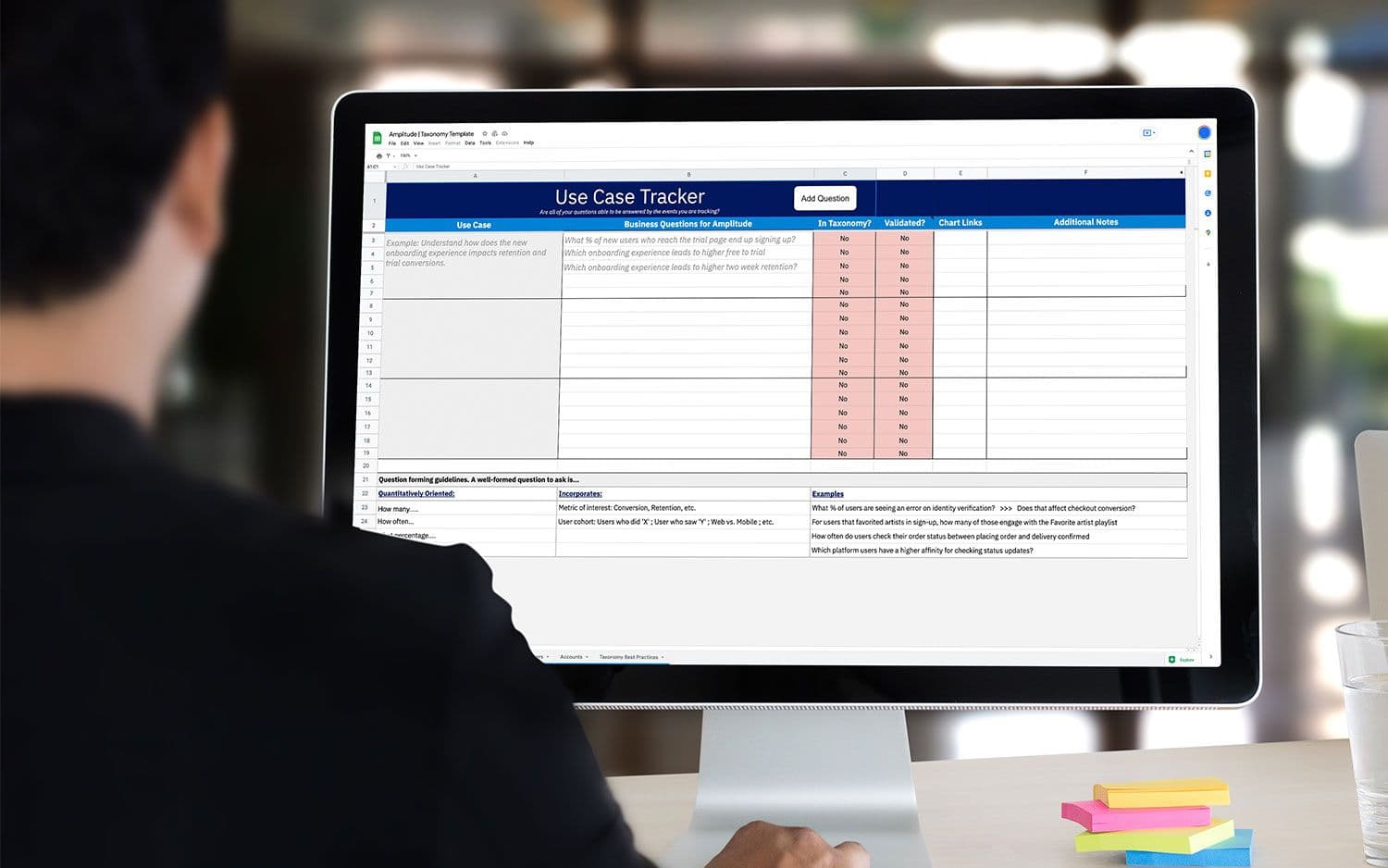
  • Question-forming guidelines such as the following example from one of our templates: “For users that favorited artists during sign-up, how many of those engaged with the favorite artist’s playlist?”

What to customize:

  • Events, descriptions, sources, and properties that align with your overall KPIs
  • Your overall business objectives to help your team stay on track

Tracking plan templates for any industry

Here at Amplitude we’ve created a tracking plan template that works across industries. One of its most popular features is a use-case tab that helps users craft well-formed questions to home in on their most critical metrics.

We’ve also created a template that includes suggested events and properties for companies in the e-commerce industry. This is a great resource to use when getting started with a tracking plan, and it can easily be built out at a later time.

Determine who should own your tracking plan

Once you have your template in place, you can assign it an owner. But why should you assign ownership over the tracking plan? If too many stakeholders are involved, it becomes shared and does not have a team or individual owner who takes full responsibility.

The owner is empowered to drive results from the data, leading to accountability and, ultimately, users trusting the data. Who owns the tracking plan usually depends on the industry and the size of the company. In most cases, the product team is best positioned to do this, as event tracking should be tied to every product launch.

Make the event tracking plan part of your development process

Of course, even the best plan will be foiled by a lack of buy-in. In order to truly make analytics tracking part of your development process, you’ll need buy-in from leadership and all the relevant stakeholders. How do you do this? To generate buy-in, invite all key stakeholders to help determine the tracking process. You need everyone on board as you make data governance a part of your culture.

The limitations of static tracking plan templates

While tracking plan templates are a good place to start, they do have their limitations:

  • Hard to keep up to date: Since it doesn’t live alongside your workflow, the template often gets lost in the mix. Updates are forgotten and it becomes unclear whether tracking was implemented or not.
  • Hard to version: Tracking plans can become very complex and hard to manage as more people get involved. With more people involved, the list of potential problems grows, such as someone overwriting another user’s changes. The good news: Amplitude’s data governance features make versioning as easy as it is in Git.‍
  • There is no way to enforce that what’s in the plan is actually in the product: This situation happens quite often, and it might even sound familiar. This problem occurs when there is a lack of culture around analytics tracking, and it is pushed aside. Note: Amplitude helps you ditch your static tracking plan by with features to enforce the schema in code, ensuring it is not ignored by developers.

Start tracking with Amplitude today

Templates are a great place to get started if you are new to implementing tracking plans. However, note that static templates do not solve the problem of making a tracking plan part of the developer workflow. That’s why Amplitude offers data governance features that integrate directly into your organization’s workflow.

Use a free static tracking template to get started, and book a demo with the Amplitude team to see the full power of integrated data governance workflows.
Contact sales
About the author
Franciska Dethlefsen

Franciska Dethlefsen

Former Head of Growth Marketing, Amplitude

More from Franciska

Franciska is the former Head of Growth Marketing at Amplitude, where she led the charge on user acquisition and PLG strategy and execution. Prior to that, she was Head of Growth at Iteratively (acquired by Amplitude) and before that Franciska built out the marketing function at Snowplow Analytics.

More from Franciska
Topics

Data Governance

Platform
  • Product Analytics
  • Feature Experimentation
  • Feature Management
  • Web Analytics
  • Web Experimentation
  • Session Replay
  • Activation
  • Guides and Surveys
  • AI Agents
  • AI Visibility
  • AI Feedback
  • Amplitude MCP
Compare us
  • Adobe
  • Google Analytics
  • Mixpanel
  • Heap
  • Optimizely
  • Fullstory
  • Pendo
Resources
  • Resource Library
  • Blog
  • Product Updates
  • Amp Champs
  • Amplitude Academy
  • Events
  • Glossary
Partners & Support
  • Contact Us
  • Customer Help Center
  • Community
  • Developer Docs
  • Find a Partner
  • Become an affiliate
Company
  • About Us
  • Careers
  • Press & News
  • Investor Relations
  • Diversity, Equity & Inclusion
Terms of ServicePrivacy NoticeAcceptable Use PolicyLegal
EnglishJapanese (日本語)Korean (한국어)Español (Spain)Português (Brasil)Português (Portugal)FrançaisDeutsch
© 2025 Amplitude, Inc. All rights reserved. Amplitude is a registered trademark of Amplitude, Inc.

Recommended Reading

article card image
Read 
Product
Getting Started: Product Analytics Isn’t Just for Analysts

Dec 5, 2025

5 min read

article card image
Read 
Insights
Vibe Check Part 3: When Vibe Marketing Goes Off the Rails

Dec 4, 2025

8 min read

article card image
Read 
Customers
How CAFU Tripled Engagement and Boosted Conversions 20%+

Dec 4, 2025

8 min read

article card image
Read 
Customers
The Future is Data-Driven: Introducing the Winners of the Ampy Awards 2025

Dec 2, 2025

6 min read

Explore Related Content

Integration
Using Behavioral Analytics for Growth with the Amplitude App on HubSpot

Jun 17, 2024

10 min read

Personalization
Identity Resolution: The Secret to a 360-Degree Customer View

Feb 16, 2024

10 min read

Product
Inside Warehouse-native Amplitude: A Technical Deep Dive

Jun 27, 2023

15 min read

Guide
5 Proven Strategies to Boost Customer Engagement

Jul 12, 2023

Video
Designing High-Impact Experiments

May 13, 2024

Startup
9 Direct-to-consumer Marketing Tactics to Accelerate Ecommerce Growth

Feb 20, 2024

10 min read

Growth
Leveraging Analytics to Achieve Product-Market Fit

Jul 20, 2023

10 min read

Product
iFood Serves Up 54% More Checkouts with Error Message Makeover

Oct 7, 2024

9 min read

Blog
InsightsProductCompanyCustomers
Topics

101

AI

APJ

Acquisition

Adobe Analytics

Amplify

Amplitude Academy

Amplitude Activation

Amplitude Analytics

Amplitude Audiences

Amplitude Community

Amplitude Feature Experimentation

Amplitude Guides and Surveys

Amplitude Heatmaps

Amplitude Made Easy

Amplitude Session Replay

Amplitude Web Experimentation

Amplitude on Amplitude

Analytics

B2B SaaS

Behavioral Analytics

Benchmarks

Churn Analysis

Cohort Analysis

Collaboration

Consolidation

Conversion

Customer Experience

Customer Lifetime Value

DEI

Data

Data Governance

Data Management

Data Tables

Digital Experience Maturity

Digital Native

Digital Transformer

EMEA

Ecommerce

Employee Resource Group

Engagement

Event Tracking

Experimentation

Feature Adoption

Financial Services

Funnel Analysis

Getting Started

Google Analytics

Growth

Healthcare

How I Amplitude

Implementation

Integration

LATAM

Life at Amplitude

MCP

Machine Learning

Marketing Analytics

Media and Entertainment

Metrics

Modern Data Series

Monetization

Next Gen Builders

North Star Metric

Partnerships

Personalization

Pioneer Awards

Privacy

Product 50

Product Analytics

Product Design

Product Management

Product Releases

Product Strategy

Product-Led Growth

Recap

Retention

Startup

Tech Stack

The Ampys

Warehouse-native Amplitude