How to Build and Think About Your Product Funnel
Learn how a product funnel is used as a tool to discover how users engage with a product at every stage of the customer journey.

Originally Published on October 31, 2022
Browse by category
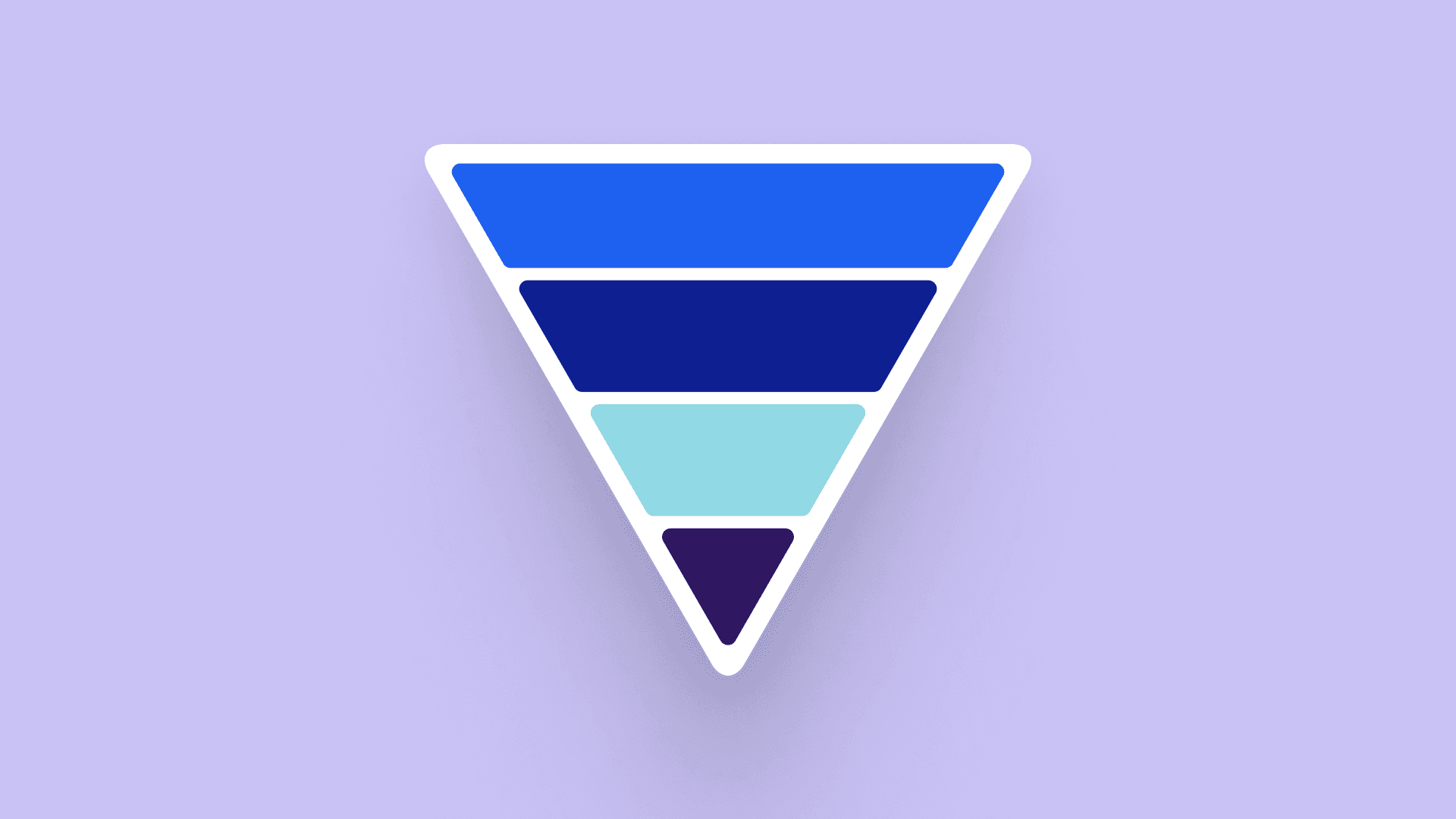
A product funnel is a tool that is used to discover how users interact with your product or solution at each stage of their customer journey.
If you’re a marketer trying to identify where customers are on their journey, or a product manager looking for ways to analyze and track these insights, it’s helpful to use a product funnel. Product funnels spotlight your product so you can figure out how to boost acquisition, retention, and monetization.
For example, a product manager could use a product marketing funnel to see how many times a user viewed a product before purchasing. They can dig into each stage of the product funnel to identify which in-product behaviors led to conversion. Meanwhile, marketers might be more concerned with what content they read before converting.
You can use these insights to refine your product-focused content and your product itself.
Key takeaways
- A product funnel is the part of a marketing or sales funnel that most directly touches the product.
- Through product analytics, you have insights into product experiences that widen what you can consider “in-funnel.”
- You need product funnels to drive attention to your business and its products, followed by product analytics to increase value and retention.
- Satisfied customers are more likely to explore your product in greater depth, entering new funnels. They’re also more likely to recommend your products to others, driving top-of-funnel awareness and product flywheels (or loops).
- Once you understand your product funnel, you should focus on flywheels to drive greater usage, value, and awareness.
- You should tailor content to where customers are in the funnel to maximize its impact.
- Top-of-the-funnel content should help people learn about your product and make it more discoverable online.
- Middle-of-funnel allows more specific product details, value, and differentiation to influence decision-making.
- Bottom-of-the-funnel content can help steer customers away from exiting the funnel and toward purchasing or re-engagement.
What is a product funnel?
A product funnel is a tool used to determine how users interact with your product or solution at every stage of their journey. A product—whether physical or digital—can have its own version of a funnel, filled with content that falls under these stages:
- Awareness: The customer learns of your brand or product for the first time.
- Interest: Your product presents a solution to the problem the customer hopes to solve.
- Consideration: The customer weighs your solution against the offerings of your competitors.
- Intent: After identifying your solution as the best option, the customer begins the process of purchasing your product.
- Evaluation: The customer makes final due-diligence decisions about purchasing your product.
- Purchase: The goal of any marketing sales funnel—the commitment from a customer to use your product as the solution to their problem.
The stages of a product funnel
You can view your product funnels as components of your marketing sales funnels. The goal is to focus on product offerings and use them to drive customer value and increase retention. To do so, you can create product funnel content to reinforce your brand’s positioning, personality, and voice. You should align your product content with your customers at every stage of the product funnel, which requires data-driven insights to determine their behaviors and perspectives.
Of course, you need to determine where customers are in your funnel before you can begin analyzing their behavior. With Amplitude Journeys, you can see the product experiences that delight customers and lead to conversion—and, conversely, what factors create the conditions for churn or friction.
The customer journey through a music-streaming app’s product funnel. Explore this chart in our free self-service demo.
Digital product funnel examples
Here are examples of product funnels and the features that can help determine how your customers behave at various touchpoints. We’ll also outline what features or messaging could be effective at those critical junctures in their journey:
- Trial periods are powerful because they give life to your product features. They allow users to jump from content marketing concepts they read about in your marketing materials to the actual product interface that could transform their business.
- Marketing teams can look at the product-focused content in their marketing funnels to see how clearly it promotes their trial offers and how well it converts. They might also use marketing forecasting to predict which segments (predictive cohorts) are most likely to convert and target trial offers to them.
- Once the user is in a trial, product managers can use conversion drivers to determine which features or product experiences correlate with conversion and which friction points lead to canceled trials or inactive accounts.
Suppose you have a music-streaming app and want to identify which behaviors correlate with conversion between viewing a song and purchasing a song.
Amplitude’s Conversion Drivers show a strong positive correlation (+0.89%) between playing a song from a recommendation before purchasing a song. This insight could inform your product funnel in several ways. For instance, marketers might update their messaging and campaigns to focus on the song recommendation feature. Or product managers might A/B test a new design to surface song recommendations more frequently to users.
- Top-of-funnel marketing content should make your product more discoverable.
- SEO-optimized written content like blog posts or ebooks can help acquire new users. Using relevant keywords ensures that new users’ interests align with your product.
- Videos and webinars can be shared as educational resources to help users learn about your product.
- Middle-of-funnel marketing content provides a deeper evaluation or validation of your product.
- Case studies, testimonials, reviews, and demo views can be used to build upon initial interest.
- Users often have similar needs and in-product behaviors. Effective customer segmentation helps to identify and group these customers into segments based on their behaviors (behavioral cohorts). You can use behavioral cohorts to identify your highest-value customers and personalize your product funnel accordingly.
Suppose you have an ecommerce app specializing in designer products and want to know whether certain brand purchases result in higher customer lifetime value (CLV), or lifetime value (LTV).
Amplitude’s Revenue LTV chart reveals that LTV for customers who purchase Coach (green) is higher than those who purchase Michael Kors (blue). You can use this insight to design more tailored marketing campaigns for your Coach brand lovers since you’ll likely see higher ROI.
- Bottom-of-funnel marketing content can help resolve issues for customers who have exited, or are at risk of exiting, the funnel:
- Outreach from sales or customer service might help to identify, understand, and resolve any areas of confusion and further inform content iterations.
- With Amplitude Audiences, you can create personalized experiences based on user behavior. This could include customized in-app journeys, personalized email messages, or other targeted campaigns to increase upsells, cross-sells, and conversions.
- Email follow-ups or paid social media advertising can help retarget users who churned, are inactive, or abandoned their cart. Amplitude’s Lifecycle chart shown below can help you identify these inactive users.
Keep an eye on your resurrected (formerly inactive) and dormant (inactive) users to understand where users are in your product funnel. Use these groups to create more targeted product and marketing campaigns.
How to build a comprehensive product funnel
A comprehensive product funnel should:
- Drive awareness of the right products for each customer segment.
- Promote flywheel effects, or loops—where interest in your product is naturally maintained based on your customers’ positive experiences.
For example, a marketer of an ecommerce platform or consumer brand website might partner with an influencer as a cost-effective way to drive awareness and acquisition among a niche audience.
If the influencer’s fans are interested in the product and convert, revenue from this new segment could lead to additional influencer partnerships. The segment might also spread the word to similar or adjacent cohorts, who might convert and spread the word even further. This is a product flywheel in action.
- Consider positioning one product as the initial hook that draws awareness and interest.
- Middle-of-funnel testimonials can showcase how other buyers of the same cohort received value from the product, making the product more relatable—and less like something being sold.
- Case studies manage the perception of bias and provide social proof, ensuring that your product funnel has the right tone.
- Pre-recorded demo videos can be a cost-effective approach to drive conversion with limited resources.
Once a user converts, the next step is figuring out how to retain their business. A comprehensive product funnel can connect a user account to the first campaign or piece of content that drew them in using multi-touch attribution. This is where it’s important to remember to think about your business in terms of flywheels, not just funnels.
For example, let’s say you’re a media publication trying to grow your readership. A flywheel might look like investing in content creators to help with acquisition, retention, and monetization. These content creators might reach new readers, who may subscribe and promote the content on their channels, allowing you to reinvest in additional content creators to reach more audiences.
An example flywheel for a media publication
You may have an intuition about what your product flywheels look like—treat this as a hypothesis, then see if your product analytics support that framework.
Learn more about what drives your product flywheel in A Guide to Flywheels.
Leveraging product funnel metrics and analytics
Implementing a product funnel requires more than simply buying into the concept. Marketers and product managers must analyze customer data, interpret the insights, and conduct experiments to optimize the experience. Product funnel analysis helps companies understand which features customers love, which still need adjustment, and which could be removed.
The good news is that these insights are measurable—with product analytics tools, a data-driven culture, and well-defined metrics.
Categories of product metrics you should measure are:
- Acquisition: A product funnel isn’t effective if potential customers aren’t buying, and it helps if existing customers are advocates. Acquisition can be gauged by the number of new signups or qualified leads and the customer acquisition cost (CAC).
- Activation: Users should feel motivated to take the next step. You can assess motivation through the activation rate, time to activate, and free-to-paid conversions.
- Engagement: If users aren’t engaged, how can they receive product value? You can understand engagement levels through the volume and frequency of interactions—or monthly, weekly, and daily active users (MAU, WAU, DAU).
- Retention: Acquired, activated, and engaged users of routinely optimized products tend to stick around. You can assess their loyalty through retention and churn rates, which are expressed monetarily as CLV.
- Monetization: To further examine revenue implications, you can look at net revenue retention (NRR), monthly recurring revenue (MRR), and average revenue per user (ARPU).
- North Star: This measurement encourages laser focus on the one thing that is most predictive of long-term success for your business.
Learn more about what each of these metrics mean, how to calculate them, and why they’re important to track in The Amplitude Guide to Product Metrics.
If you’re a product manager, you can work with your marketing team to optimize your acquisition and activation. From there, you can dive into the engagement and retention metrics to see which features are compelling and which ones are potentially confusing. Highlighting value and reducing friction will supercharge your product funnel.
You can also leverage product analytics to learn about your most engaged customers. What features do they tend to use? What future actions are they likely to take? You can use these insights to discover new ways of creating value for your power users while looking for ways to reduce friction for less engaged users.
A few things to remember when analyzing your product funnel:
- Analytics can reveal whether a user is visiting for the first time, has made purchases in the past, or has received offers/trials/demos.
- Engagement metrics (quantifying the amount of user engagement) can inform the frequency of prompts/offers/ads/reminders.
- Conversion drivers can reduce friction, increase the relevance of middle-of-funnel content, and send users further down the product funnel.
- Grouping similar users into behavioral cohorts allows for better experimentation and insights, ultimately leading to more relevant and compelling content.
- Robust analytics make product and customer behavioral insights immediately and easily accessible to anyone within your organization.
- Personalization can help you drive conversion by crafting the right message to users based on their behaviors.
Using product funnels to unlock product-led growth
Product-led growth is commanding more attention as businesses look for ways to operate in a cost-effective, customer-centric way. Marketers and product managers are well-positioned to leverage their product funnels to unlock growth.
Using product funnels to discover how your users interact with your product makes you well-positioned to optimize your product, take action based on the interest of new customers, and create loyal brand advocates.
Understanding data can be overwhelming, but with easy-to-use and self-service analytics tools, you don’t need to be a data scientist to uncover what excites your customers about your product. Get started with a free Amplitude account today to see how your customers are moving through your product funnel.
Resources
- What Is Funnel Analysis? Definition, Examples, and Tools (Blog Post)
- Build and Analyze a Funnel Analysis Chart (Video)
- Funnel Analysis and Its Use Cases (Live Session)


Christopher Selden
Former Principal Product Manager, Data Connections, Amplitude
Christopher Selden is a former principal product manager at Amplitude, driving development for data products such as Amplitude's data warehouse and cloud storage products, as well as their integration infrastructure. He previously worked as a product manager focusing on data management and new products at Samsung and Criteo.
More from Christopher


