First-Party Data: What It Is, Importance, & How to Gather It
Learn how to collect first-party data and use it to create personalized customer experiences and improve retention.


First-party data is information your organization gathers about your customers via a channel you own, such as your website or mobile app. It includes data that users share, like when they enter their email addresses into a form, and data from their on-site or in-app behaviors.
Key takeaways
- First-party data is information you gather when people interact with your product or service.
- Data you collect directly from your customers is more helpful in improving your product than second- or third-party data.
- Collect first-party data at different touch points with your customers—for example, when they fill out a form on your platform or complete different processes.
- You can activate first-party data to improve the customer journey, personalize the customer experience, and inform your digital marketing efforts.
What is first-party data?
First-party data is information you collect from your customers about why they interact with your core product. In contrast, second and third-party data comes from an audience’s interaction with an external platform.
There are two main types of first-party data.
- Entity data: information about the user’s identity (like age, location, and gender) and their preferences (like the genre of movies they like to watch)
- Event data (or behavioral data): information about actions users take in your platform (like clicks, hovers, or adding to cart)
You collect first-party data about individuals, and you can sort the individual users into groups (or cohorts) to analyze them. For instance, you might have a group of people from the same organization who use your platform, and you can use cohort analysis to analyze them as one group. You can also create cohorts based on shared user behaviors—such as people who activated notifications in the first week or shared a playlist with friends.
The key feature of first-party data is that it belongs to your organization. You collect, store, and manage it yourself. You control how you gather the data, which means you can be sure of its accuracy and legality. This feature is different from second- and third-party data.
First-party data vs. zero-party data
People have started to use the term zero-party data to refer to information that customers actively share, for example, when they respond to a poll or a customer feedback questionnaire. Zero-party data can give you useful insights, but it’s self-reported, so it might not be accurate.
Someone might report that their favorite movie genre is horror, but they spend 90% of their time on your movie platform watching rom-coms. Similarly, most users might answer that they’re ‘extremely likely’ to recommend your platform to a friend, but only a fraction use your refer-a-friend program.
For the purposes of this article, we’re counting zero-party data as a type of first-party data. It comes from a direct relationship with your customers via your product, and you own the data.
First-party data vs. second-party data
Second-party data is data you get from a trusted partner, such as social media or an advertising company. It’s essentially the first-party data of another organization, and when they share it with you, it becomes second-party data. The benefit of collecting second-party data is that it can allow you to achieve greater scale by supplementing the data you collect.
A common scenario is when the partner organization collects data on users who may or may not be users of your platform and shares it with you so you can act on that data. For example, a publisher may share its first-party audience data with an advertiser who wants to run ads on its website.
First-party data vs. third-party data
Third-party data is data you get from a data aggregator. Third-party data providers group together and organize sets of second-party data.
A third-party data set can give you information about a general group, for instance, a demographic or people who work in a specific industry. However, you won’t know the details of the original source of the data, like when or how it was collected.
Third-party data is usually available to buy on an online platform like Snowflake Marketplace. Third-party data providers have a data exchange to provide data scientists and analysts access to a growing number of live and ready-to-query data sets. However, the issue is if you can buy it, your competitors can too, so it doesn’t necessarily give you a competitive advantage.
A lot of third-party data also comes from third-party cookies, where a data aggregator pays other organizations to track their site visitors via cookies. This practice is ending, as Google has stated it will get rid of third-party cookies.
In recent years, the EU and different states in the U.S. have also passed stricter laws (like the GDPR and CCPA) about data collection, data privacy, and data sharing. It’s becoming more challenging for organizations to collect and share data due to the legal implications.
Summary
Here’s a recap of first-party data vs. second-party data vs. third-party data.
| Data type | Definition |
| First-party data | Information that comes directly from your customers—including data you collect and data they share. |
| Second-party data | Information that comes from another data partner or provider. |
| Third-party data | Information that comes from a data aggregator that groups second-party data together. |
First-party data examples
There are many different types of first-party data because any data you gather from within your product is first-party. Here are examples of the main types of first-party data.
User attributes
User attributes include your users’ names, ages, locations, and personal data such as addresses and phone numbers. You gather user attribute information when users sign up for your product, fill out any forms, or from your web analytics.
User preferences and interests
Another benefit of collecting first-party data is that you learn information about your customer’s preferences and interests based on different data points. For instance, users who watch more than three hours of beauty tutorials per day on your platform are probably interested in hair and makeup products.
Or maybe you notice a group of people who use your invoicing template several times a week. You can hypothesize that they probably find invoicing templates valuable and might be interested in similar templates.
Customer behaviors
User behavior is another first-party data source. You can track and analyze different events to understand how people interact with your platform. For instance:
- Time users spend on different pages on your site
- How often they use different features
- Buttons or links they click
- Processes they complete (like the sign-up or subscription upgrade process)
You can use cohort analysis to segment users into different groups based on their behaviors—behavioral cohorts. Returning to the invoice template example, maybe you hypothesize that those who use these templates have higher customer lifetime value (CLV) than those who don’t.
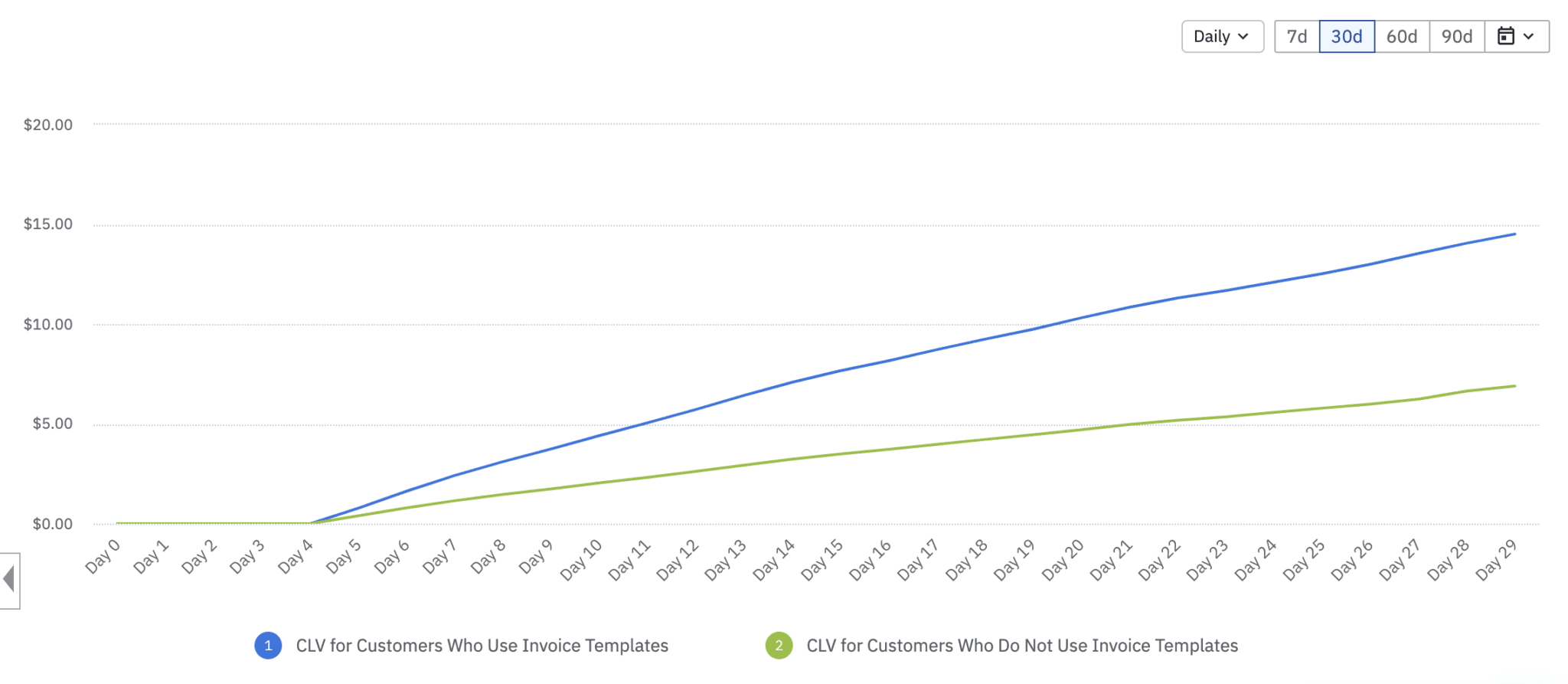
The Amplitude Revenue LTV chart above confirms your hypothesis—those who use invoice templates (blue) have higher CLV than those who don’t (green). Your next step should be A/B testing a change to surface invoice templates earlier in the customer journey to increase CLV.
Interested in seeing which users have the highest CLV for your product? Get started with a free Amplitude plan, or explore this chart in our self-service demo.
Why first-party data is important
It’s important to understand where the ingredients in your meal came from—that way, you can be sure you’re not putting something harmful into your body. It’s the same with data. You don’t want to ingest potentially inaccurate or low-quality information into your organization because it’ll wreak havoc on your business decisions.
The primary benefit of collecting first-party data is that your organization has more end-to-end control of how you collect, analyze, and activate data. That means you can be sure of its quality and accuracy, and you don’t have to rely on a partner or a third-party organization. You’re also ensuring that you’re adhering to all privacy laws and regulations and that you have the proper consent from your users before collecting their data.
Additionally, first-party data allows you to be flexible. You can update it, add to it, and create different audience segments and cohorts—which might not be possible if you’re getting your info from another organization.
Lastly, first-party data is, by nature, highly relevant to your customers and your product. All of the insights you gather are specific to your platform, which means you can activate it and create a first-party data strategy to improve your app or website.
You can activate first-party data to:
- Improve thecustomer experience and retention by identifying and resolving friction points in the customer journey.
- Create a personalized experience by adapting your product to the preferences of different audiences and cohorts.
- Make your marketing more effective by using marketing forecasting to identify power users, retarget your advertising, or double down on an acquisition channel.
How to collect first-party data
You can collect first-party data by tracking events (like clicks, views, and processes) in your product and by encouraging customers to interact with your platform. To decide which events to track and what data to gather, start by listing the questions you have about your customers and their product usage. Next, define the events and event properties that’ll help you uncover the answers. For more information, check out our detailed guide to event tracking decisions.
Here are instances of touchpoints where you can gather useful data from your customers:
- User registration: Collect data from users when they sign up to your platform. Social login allows users to log in with an existing social account like Facebook or Google. It makes it simpler for people to log in and share their customer profiles with you.
- Lead generation forms: To gather more information, use a lead generation form to ask users to share more details than the typical registration and onboarding information. For instance, create a lead magnet where you ask customers to share what industry they work in or their company size in exchange for access to a valuable whitepaper.
- Interactive content: Encourage users to share more details with interactive content. Set up an entertaining experience for your user—like a poll or an interactive survey—and collect more information about their interests and preferences.
First-party data tools
There are several data management platforms for gathering, processing, and analyzing data. The best one for you will depend on the size of your organization, the type of your organization, and your specific data needs.
Amplitude
Amplitude Customer Data Platform (CDP) allows you to collect and organize different types of data. It’s fully integrated with Amplitude Analytics, which means you can easily send your data downstream to analyze and activate it based on your marketing or product strategy.
With Amplitude, you can segment data into different audiences (cohorts) to run self-service analyses and gather valuable insights. An easy-to-use platform helps your organization be data-driven. It eliminates data silos and empowers people in all departments to access data insights and use them in their work.
Other data tools
Learn more about how to collect, analyze, and activate first-party data in The Amplitude Guide to Behavioral Data & Event Tracking.
References
- Level Up Your Loyalty Marketing With Zero-Party Data, Forrester
- Second Party Data: Definition, Benefits, & Use Cases, Permission
- The big reset: Data-driven marketing in the next normal, McKinsey

Brandon Khoo
Former Senior Product Manager, Amplitude
Brandon Khoo is a former Senior Product Manager at Amplitude, leading the strategy and development of the Amplitude's insights-driven customer data platform. His role also involves defining the integration infrastructure for Amplitude’s partner ecosystem. Brandon is an alumnus of Uber and KPMG, and he holds degrees in Electrical Engineering and Finance from the Queensland University of Technology.
More from Brandon


