How to Elevate Healthcare Experiences with Digital Analytics
Dive into healthcare analytics with insights from experts Adam Greco and Tucker Christiansen.

Healthcare is a complex industry. Organizations in the healthcare sector provide a range of services like scheduling, connecting patients with documents and test results, bill paying, and insurance. They’re essentially juggling several business models at the same time.
Add to that a strong emotional dimension. People interact with healthcare companies at their most vulnerable moments and about the most important aspects of their lives.
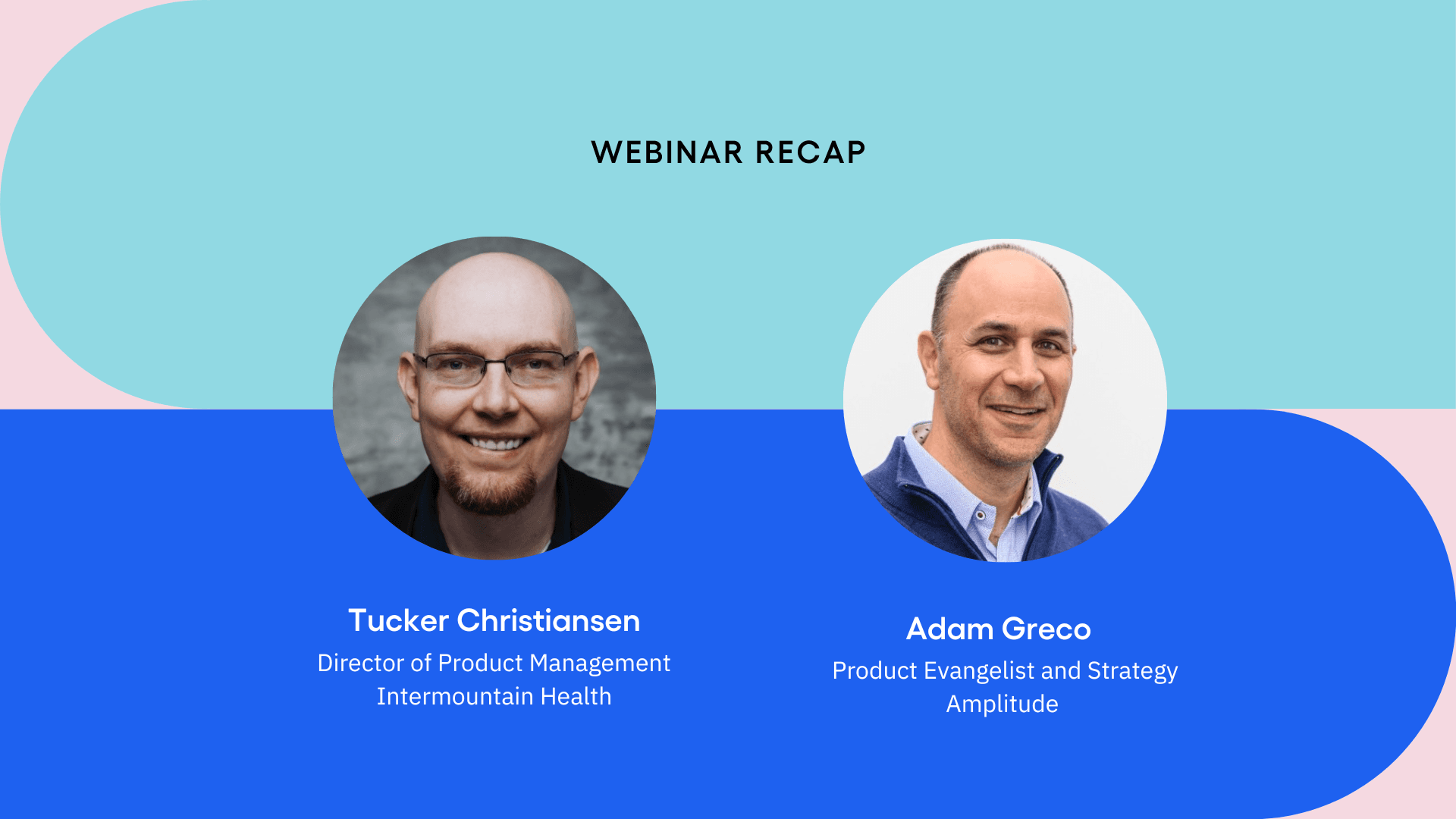
Amplitude hosted a webinar focused on how digital analytics and the data-driven insights it yields can help improve patients’ digital experiences with healthcare organizations. The webinar featured Tucker Christiansen, director of product management at Intermountain Health, and Adam Greco, product evangelist at Amplitude.
Key Topics
- Navigating the complexities of digital healthcare experiences and changing customer expectations
- Using analytics as a foundation, not an afterthought
- Turning passive data collection into continuous data-backed action
- Collecting data in a way that complies with regulations and protects patient information
Read highlights from the event below, or tune into the full webinar—Digital Analytics for Healthcare—for all the best practices Tucker and Adam shared.
Prioritize a strong digital experience
The “digital front door” concept emerged in the healthcare industry in about 2018. The idea is to offer one login for a single site or app where patients can complete all healthcare-related actions.
At first, Tucker says, the experiences were “a bit spotty.” For example, he shares that though the Intermountain Connect Care team has offered great digital experiences, including telehealth visits, for quite some time, “If you look at your average clinic, most providers, [had] never done it before. . . . [and they were] not really too familiar with the technologies.”
Covid changed everything. To reduce transmission, providers had to pivot. “Every provider was learning how to do a telehealth visit,” Tucker recalls.
Fast forward to today. Tucker explains that the Intermountain platform often sees traffic higher than it had at the height of the pandemic. Patients are “liking digital. They’re seeing how it augments their healthcare, and they don’t want that going away,” he explains. In addition to telehealth visits, patients want to engage digitally with their providers, such as by messaging their doctors.
Put simply: “Consumer expectations have gone up.” Tucker recounts that customer feedback says people choose their doctors based on their digital experience. “Loyalty to your doctor alone isn't enough. You need that digital experience as well.”
When it comes to the healthcare experience, there’s also a lot at stake. The quality of the digital experiences healthcare companies provide enormously impacts people’s lives.
Tucker shares the example of a family going on holiday to Mexico. They had forgotten their Covid documentation, which would have meant they couldn't enter the country, ruining their holiday and potentially costing thousands of dollars. The family used the Intermountain Health app during the flight to access their documents and then showed them at the airport in Mexico.
Build in analytics from the start
An understanding of your customers is the key to creating a great digital experience. Digital analytics is an essential part of how you build that understanding. But it doesn’t work as an afterthought.
During his time as an analytics consultant, Tucker says many customers would spend months building a new experience and go live without analytics, missing some of the most important initial data. Then, they’d spend the following month implementing the analytics.
Tucker argues that it’s faster and more efficient to build event tracking into your product from the start. The Intermountain team doesn’t ship anything without analytics. He shares a story about when they launched a new feature. Everything was ready to go apart from analytics, so the team decided to push the launch back by one week.
Two other things that help the Intermountain team are standardized taxonomy—so it’s clear what event properties to track—and collaboration. The product team works alongside the engineering team on this process: “We don’t design a solution . . . and then they go build it,” Tucker says. “We’re collaborating with them on the solution itself.”
Document your taxonomy with our free event tracking plan template.
Use data as a thermostat, not a thermometer
Adam explains that using data as a thermometer means you check the data regularly without taking action. When you use data as a thermostat, you continuously implement changes based on the information you get. Tucker agrees, saying that those who use data consistently are more successful at improving user experiences.
“There's a huge difference when you look at a team that is data-driven and constantly feeding on that data and using it to fuel every decision versus a team that gets their reports once a week or once a month from a centralized analytics team,” said Tucker.
Adam adds that he’s shocked by how many people get “stuck thinking that analytics is all about reporting instead of making changes because of data.” He also emphasizes the importance of involving your whole team so everyone uses data. Data democratization is crucial to making that happen—self-service data enables everyone on your team to access product insights.
Case study: Intermountain Health revamps appointment scheduling
With patient appointment scheduling, there are generally two use cases. Established scheduling occurs when someone books an appointment with a doctor they know. They have simple questions to answer, like when to schedule follow-up appointments or annual checkups and if they’d prefer video or in-person meetings.
The more complicated use case is new provider scheduling. New patients don’t have loyalty to a doctor or a healthcare provider.
The use cases affect the priorities of each user. For instance, an established scheduler might be happy to wait a few weeks to see the doctor they know. In contrast, someone scheduling for the first time is likely less willing to wait.
By analyzing user behavior, the Intermountain team found that scheduling flow abandon rates were much higher for new schedulers. While the team expected the flow completion rates to be lower because new provider scheduling is a more complicated flow, Tucker recalls the team asking, “Should it really be this much lower?”
The team realized users would reach the calendar page a few clicks into the flow. That was fine for established patients. But doctor availability was a key decision point for new schedulers, and the flow forced them to click back and forth to get the information they wanted.
Tucker explains the Intermountain team created a mock-up of a new flow, then did some prototyping and usability testing with consumers. Once they found a version of the flow that worked for consumers, the engineering team figured out how to build it. Then Intermountain A/B tested the new version compared with the old version.
The new version performed 39% better in terms of appointments scheduled. “We ran the test for two weeks and couldn’t wait any longer. We immediately cut it off and sent everyone the new experience,” says Tucker. Though scheduling is not the highest usage feature, it is the top driver of five-star reviews and Tucker considers it to be a main contributor to exceeding customer expectations.
Combine different kinds of data
Behavioral data shows you how customers behave in your product. To get a complete picture of customers, combine behavioral data with different types of qualitative data, like reviews and surveys. Connecting different data sets helps you understand why customers behave as they do.
“Talking to consumers . . . nothing replaces that,” Tucker says. The Intermountain team collects customer feedback by sending a monthly survey and regular experience impact surveys to randomly selected users. Even when people abandon a flow, Intermountain invites users to share feedback about why they abandoned it.
“That can give you some really good information to augment your digital analytics data,” says Tucker. By combining the two, you understand user problems better.
Share insights with other teams
Product teams possess a wealth of insights into behavioral data thanks to analytics. Sharing those insights with others in their organization can go a long way in improving the customer experience. For instance, perhaps a product team realizes that patients struggle to book services because there is a shortage of appointments. Sharing that information with the right teams might lead to adding more providers or appointments.
Be proactive about compliance
When it comes to healthcare, security is paramount. Though product managers don’t sit on legal teams, it’s important they’re mindful of regulations in the healthcare industry.
Collaborate with legal teams
Tucker recommends that product teams develop a collaborative relationship with legal privacy and compliance teams. Legal teams can help product teams understand the details of regulations. And together, they can work to manage risk and develop solutions.
Get vendors to sign a BAA
Tucker says it’s important to only collaborate with vendors that agree to sign a business associate agreement (BAA) to ensure you protect customer data. Those agreements guarantee that vendors will “protect the patient information as if they were also part of your company,” says Tucker.
“Having the BAAs in place . . . owning the data yourself, that all helps you make sure you're doing the right thing for your patients.”
—Tucker Christiansen, Director of Product Management, Intermountain Health
Adam adds that one of the reasons Amplitude has been so busy in the healthcare industry is that Google Analytics doesn’t sign BAA agreements. As a result, healthcare companies are searching for alternative vendors.
Only track what's necessary
Just because you can track something doesn’t mean you should. “There's a tremendous amount of data in health care, and not all data should be everywhere,” says Tucker. Product teams can often get the data they need to understand user behavior without clinical data.
For example, if you want to know how people navigate between visit summaries and test results, you can track their behaviors on each page, but you don’t need to track the actual clinical values of the test results.
Leveraging analytics to create digital experiences customers expect
For healthcare providers, a strong digital experience is no longer a “nice to have.” Analytics platforms like Amplitude, which provide valuable insights into user behavior, are essential to creating those positive interactions.
For more insights from Tucker and Adam, tune into the full webinar: Digital Analytics Best Practices for Healthcare Companies.

Julia Sholtz
Former Group Product Marketing Manager, Amplitude
Julia is a former product marketer at Amplitude. She focuses on go-to-market solutions for enterprise customers.
More from Julia


