Sales-Led Growth vs. Product-Led Growth: Why Not Both?
Learn how to combine sales-led with product-led growth tactics.

It’s true that product-led companies often produce faster revenue growth and greater market share than traditional sales-led organizations. But if your company has been operating a sales-led growth (SLG) motion for years, there’s no need to scrap it all and start over. Sales-focused organizations can also benefit from product-led growth tactics. Product-led growth (PLG) strategies, such as leveraging user-generated content, offering product demos, providing free trials, and running nurture campaigns, can support the entire sales pipeline.
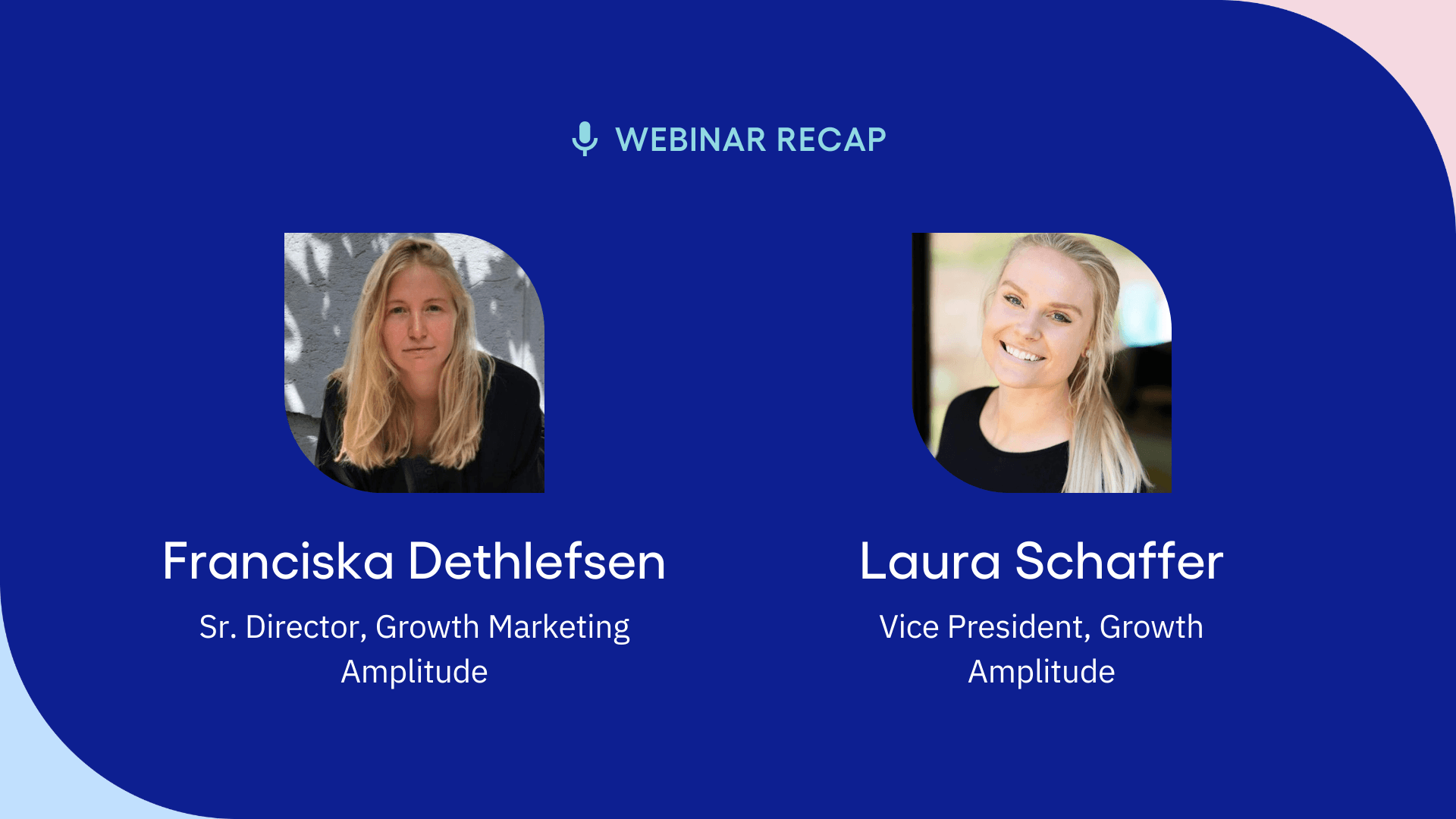
In a recent webinar, Laura Schaffer, VP of Product Growth, and Franciska Dethlefsen, Amplitude’s Head of Growth Marketing, explain how unifying PLG and SLG tactics boost acquisition, monetization, and retention efforts.
Watch the full webinar Unlock the Power of Product-Led Growth, or read on for a recap of the discussion.
Key topics
- Why you should consider adopting PLG tactics in SLG models
- How to align your teams to drive PLG with the help of KPIs
- How PLG tactics work throughout the sales funnel
- Real-life examples of PLG success
Why adopt PLG tactics in an SLG model
Many assume product-led growth focuses solely on creating a self-serve experience for users. In reality, PLG supports users at every stage, from acquisition to retention.
One limitation of a sales-led growth approach is the silos between product, sales, marketing, and customer success teams. Marketing tends to take care of acquisition and passes on those leads to sales teams. On the other end of the sales process, customer success teams take over and are usually responsible for the rest of the customer lifespan, from retention to growth.
This disconnect between teams isn’t present in PLG strategies. With PLG, everyone in the organization plays a role across the funnel. “With PLG, everyone could be responsible for the acquisition stage,” says Franciska. Product teams can drive acquisition through user invites or side products, while marketing and product teams work together to attract site visitors. The goal shifts from marketing qualified leads to signups or driving users to a trial experience.
“Now, not everyone is pure PLG or pure SLG. We’re all on a journey in one direction or the other,” Franciska explains. Many adopt a unified approach, which offers benefits such as:
- Generating a wider pool of leads by combining sales and marketing tactics
- Building stronger customer relationships from the start of their journey
- More personal user experiences, as users are self-serve but also have access to personalized assistance from customer success teams
- More data-driven insights using information gathered from direct customer feedback as well as user behavior data
The trick, Franciska argues, is “thinking about the tactics that best cater to your end users and their adoption. Bring experimentation into your business.”
Three principles to align teams to drive PLG
Breaking down silos and fostering cross-departmental collaboration requires a significant shift in mindset, company culture, and ways of working. Here are three basic principles to get your teams working together seamlessly to drive product-led growth.
1. Embrace cross-functional collaboration
“Growth is a team sport,” says Laura. Each team has a big role to play and, more importantly, they have to work together if you’re going to get high self-serve value to your customers. It’s essential for your organization to understand and embrace this culture of cooperation.
2. Create efficiency and clarity of focus
While it’s crucial for everyone to work cross-functionally, it can also create confusion due to unclear processes, roles, and responsibilities. That’s why it’s important for each team and individual to be clear on their focus areas, tasks, and priorities. “Clear focus areas, critical metrics, and specific objectives all help to achieve this,” says Laura.
3. Set clear KPIs to measure and communicate progress
Choose the key performance indicators (KPIs) and product metrics that will give you the clearest picture of your progress toward achieving your goals. Regularly collect updates, analyze insights, and communicate them effectively across your organization.
How to implement and measure PLG throughout the sales funnel
To set your team on the path to adopting PLG, you need to identify core KPIs to measure at every stage of the funnel. Your teams should be assigned specific roles and responsibilities aimed at achieving these KPIs.
Acquisition
Some KPIs you could consider at acquisition stages are:
- The number of unique visitors to your website
- The percentage of unique visitors who sign up for your product
Your marketing team is responsible for optimization and experimentation on those key channels where you’re trying to attract more eyeballs.
Product teams assist the marketing team with their experimentation by building a website infrastructure that makes it easy for them to carry out their tests.
Sales and customer success handle outbounding to drive conversion from TOFU down the pipeline.
Monetization
Useful monetization KPIs to measure include:
- The percentage of customers who move from a free to a paid plan
- Which customers move from self-serve to sales-led paid plans
Here, your marketing team is in charge of all out-of-product experiences. This includes tailored email campaigns, community, and enablement tactics.
Product will focus on building intuitive self-serve experiences within the product. This will help customers find value in your product much easier and encourage them to take desired actions, such as upgrading to paid plans.
The sales team will work with middle-of-funnel (MOFU) and bottom-of-funnel (BOFU) customers, identifying ideal customer profiles (ICPs) and trying to engage with them. To do this, they’re also enlisting help from your marketing and product teams.
Retention
There are several KPIs that help you ensure customer satisfaction and create the conditions for renewals and expansion. For example:
- Activation KPIs, such as the number of signups who reach value
- Engagement KPIs, such as the number of users that are meaningfully engaging with your product on an ongoing basis
- Churn KPIs, like the percentage of paying customers who either cancel their subscription or reduce their spend
Again, your marketing team is responsible for the out-of-product experience, using tactics such as email campaigns aimed at driving renewals. They are identifying high-value customers or any product functionality that tends to drive higher retention.
The product team optimizes the in-product experience in order to ensure people discover the value of “sticky” features.
Sales and customer success teams focus on checking in on customers to see how things are going and keep them engaged, loyal, and retained.
For more advice on how to get started with PLG, check out the Product-Led Growth Guide Volume 2.
Real-life examples of PLG done right
Reading up on tips and principles of PLG is a great way to learn and get started, but it also helps to look at the industry leaders who are using PLG tactics for enterprise sales.
How Figma relies on its own users to acquire new customers
The company behind the collaborative interface design tool, Figma, has invested heavily in building a process that allows users to invite others in a way that is as easy and frictionless as possible. There’s no need to download any external apps or sign up. Invitees get immediate access and value and can choose to sign up once they’ve experienced that value.
Figma is a great example of a B2B SaaS company using PLG in an enterprise setting. “You attract your first user, get them excited about the product, and get them to use it. Then, they invite their team members, and Figma accounts start to spread across the whole organization,” explains Franciska.
Figma attracts many of its first-time users through invites alone.
Amplitude on Amplitude: How we launched a self-serve plan to boost conversion rates
One of the questions we asked ourselves on our PLG journey was, “Are we asking customers to take too big of a leap between plans?” This is why we launched our self-serve Amplitude Plus plan. We developed Plus as a staircase plan between our free and lowest-priced enterprise plans.
Our marketing and product teams have been working on improving pricing and packaging as well as the discoverability of our features and plans. “That means having that value staircase in the pricing and packaging and then unlocking that within the product experience through marketing touches,” says Franciska.
Since we launched Plus, we’ve seen a 15x increase in our free-to-paid conversion rate.
Embrace PLG
Implementing PLG is all about meeting users where they are. Companies that use PLG are able to drive more revenue due to changing consumer expectations. “Folks are looking for self-serve value. They have these high expectations of being able to sign up and immediately understand your product and get value out of the gate,” says Laura.
Embracing PLG will help you meet these expectations and put you ahead of the competition.
Watch the full webinar Unlock the Power of Product-Led Growth to learn more about how you can get started with PLG today.

Michele Morales
Senior Product Marketing Manager, Amplitude
Michele Morales is a product marketing manager at Amplitude, focusing on go-to-market solutions for enterprise customers.
More from Michele


