What Is Behavioral Analytics? Definition, Examples, & Tools
Learn the essentials of behavioral analytics so you can personalize your digital products and drive business outcomes for your company.

Originally Published on January 28, 2022
Browse by category
Behavioral analytics gives you the ability to find out exactly how your customers are using your product. With this information, you can continuously improve, adapt, and mold your product into the experience your customers are seeking.
What Is Behavioral Analytics?
Behavioral analytics is the process of collecting and analyzing data from actions performed by users of a digital product, such as an app or website. With this data, companies can see exactly how users interacted with the digital experience, and make decisions about how to improve digital products in the future.
Examples of User Behaviors Relevant to Behavioral Analytics
- Creating an account
- Filling out a form
- Playing a song
- Abandoning a cart
- Purchasing a subscription
These behaviors, otherwise known as events (for event-based analytics), are tracked in order to reveal user preferences, intentions, and habits. The better you understand your customers, the more value you’ll be able to offer them. And, in turn, you’ll nurture a loyal customer base that sticks around for the long haul.
Key takeaways
- Behavioral analytics refers to the method of tracking and analyzing user behavior in order to better understand what they want from your product or service.
- Data generated from behavioral analytics can be used to improve your product, satisfy customers, and boost key performance indicators.
- How you use behavioral analytics is dependent on your goals, but conversion, retention, and engagement are universally essential.
Third-Party Data vs. First-Party Data
Third-party data is aggregated by other companies and then sold. This kind of information reflects who prospects and customers are but not what they want. Age, occupation, and location are examples of third-party demographic data. You’ll likely have users with identical demographics, but that doesn’t mean they’ll use your product the exact same way.
Behavioral analytics captures each individual’s unique flow through a digital experience. This is known as first-party data. Through first-party, behavioral data, you can develop an authentic understanding of how users truly perceive your product.
The Importance of Behavioral Analytics for Your Business or Brand
The goal of behavioral analytics is to empower you to make informed decisions that drive specific business outcomes for your company. Increasing high-value metrics like retention, conversion, and engagement is extremely difficult if you can’t understand what’s influencing your customers at every stage of the customer journey.
Depending on surveys, questionnaires, reviews, and feedback is not a viable long-term solution. Customers’ actions convey much more meaning than words, and understanding how cohorts engage with the digital experience is key to driving critical metrics like customer lifetime value.
Data points like daily active users and bounce rates can help you determine where prospects come from and how long they stay but not necessarily why they choose your product. Without knowing the intent and motivation of your customers, any changes you make to your product will be based on intuition.
When it comes to placing digital bets on product improvements, the only way to ensure your efforts will pay off is to know exactly what the customer wants. According to McKinsey & Company, “organizations that leverage customer behavioral insights outperform peers by 85 percent in sales growth and more than 25 percent in gross margin.”
Behavioral analytics gives you raw data that can be used to form hypotheses, conduct A/B testing, and make changes with confidence. This constant refinement is what leads to highly personalized experiences that deliver value through every interaction and feature.
How Does Behavioral Analytics Work?
Before you can start extracting insights from your behavioral data, you’ll need to invest in a behavioral analytics solution such as Amplitude’s Digital Analytics Platform. Your analytics platform should collect user behaviors from your product and/or a data warehouse or CDP, as well as integrate with other tools like social and email messaging systems. You’ll then be able to visualize the behavioral data through a dashboard or reporting system.
Once you’ve gathered behavioral data, you’ll need to define the specific business goals and objectives you want to achieve. These goals are native to your company and product, but things like retention, conversion, and engagement are virtually universal to every business. If you don’t have specific short- and long-term business goals, it will be much harder to draw insights from your behavioral data.
Ultimately, your core goal is to understand as much about your customers as possible: what they want, what they don’t want, and what keeps them engaged. To answer these questions, you can use a tool like Amplitude to examine the behaviors and preferences of a group of users. These groups are known as behavioral cohorts.
By looking at the behaviors of certain groups, user patterns and tendencies emerge. Segmenting cohorts based on specific behaviors helps you discover opportunities to improve the entire customer journey.
You can segment users based on almost any behavior: skipping a song, accepting a free trial, or canceling a membership. Once you’ve created behavioral cohorts, you can leverage other analytics methods like A/B testing and funnel analysis to extract deeper insights.
Regardless of how you decide to segment behavioral cohorts, you should always aim to find out why a user did something. Once you understand intent and motivation, you can efficiently make changes related to your business goals.
Different Types of Behavioral Analyses
Once you’ve collected behavioral data, you can run different types of analyses, tests, and experiments based on your goals. Not all behavioral analytics platforms offer the same capabilities, but a solution such as Amplitude will give you the ability to conduct the below analyses and more.
A/B Experimentation
A/B experimentation lets you make product decisions with confidence. Not sure about a landing page? Wondering if a product feature is worth the trouble? Instead of making changes to your product based on intuition, you can determine the best course of action using tangible data generated from customer behaviors.
Armed with user behavior data, you can make big-picture adjustments that improve the customer experience without taking any chances.
Funnel Analysis
Every path a customer takes toward conversion presents an opportunity for progress or drop off. Funnel analysis enables you to examine every stage of the customer journey so you can fix pain points and/or confirm winning experiences.
As your business grows, you’ll likely have more funnels to maintain and optimize. Platforms such as Amplitude give you a holistic overview of all your funnels so you can understand user intent at every level.
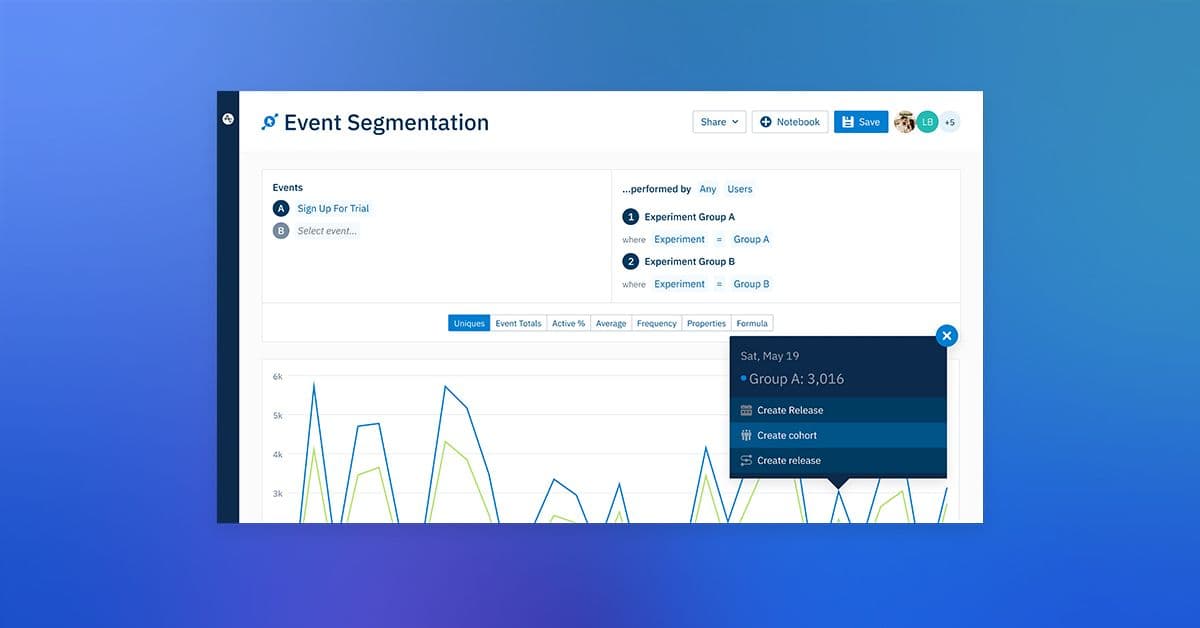
Segmentation
Segmentation lets you discover trends and patterns by comparing groups of users and behaviors over time. For example, your product will likely find success with a group of core users who know your product inside and out.
If you segment that audience and pay attention to their behaviors, you can locate the most valuable aspects of your product. Then you can incentivize new users to engage your product the same way as your power users.
How to Start Using Behavioral Analytics Tools
Every business is subject to its own specific challenges and industry expectations—the way you implement behavioral analytics will be native to your short- and long-term goals. However, team-wide adoption of behavioral analytics will set the stage for success. The below guidance will give you a few examples of how to start using behavioral analytics.
Establish a Cross-Functional Data Strategy
Many companies admit that they haven’t achieved an effective culture around data, despite its growing importance. According to Gartner, “by 2023, organizations that promote data sharing will outperform their peers on most business value metrics.”
Each team within your business can provide unique perspectives on how to maximize the value of behavioral data. The combined expertise of each department should inform your data strategy. What goals and metrics should we track and why? How will this data be used to build a better product? Is our tech stack capable of accomplishing our goals?
These questions are best approached by as many teams as possible: product, marketing, c-suite, IT, analysts and even customer support. Once goals have been established, it’s equally important to prioritize data democracy. This gives multiple teams access to your data which translates into a better product and increased business outcomes.
Invest in a Platform and Train Your Team
Finding the right analytics platform is dependent on your goals, budget, and analytics maturity. Not all platforms are created equal so it’s important to find a solution that meets your needs. Some platforms are more user-friendly than others.
For example, Amplitude’s Digital Analytics Platform offers a unified suite of tools that give you an in-depth understanding of why customers engage with your product. Amplitude pulls behavioral data from all of your digital touchpoints into user-friendly dashboards, enabling you to conduct experiments, analyze funnels, test new features, personalize marketing campaigns, and more. When it comes to training your team, Amplitude also provides knowledge databases, training courses, and webinars.
Connect Your Platform to Your Product and Other Tools
Your product will likely provide the majority of your behavioral data, but you may have other data sources that can be integrated into your analytics platform. For instance, a Facebook Ads integration can leverage your product data and create custom audiences, giving you more opportunities for personalization.
Tools like Braze automate marketing initiatives giving you the ability to engage users through multiple channels. You can integrate Braze to your behavioral analytics platform for increased productivity, customization, and flexibility.
Real-World Examples of Behavioral Analytics
Behavioral analytics is a powerful tool because it enables you to tackle obstacles in limitless ways. The best way to understand what’s possible with behavioral analytics is to see how companies are using it to solve specific challenges.
ClearScore Boosts Subscriptions with Funnel Analysis
The moment a prospect becomes a customer, they enter a product funnel. As the user interacts with your product, they move “down the funnel” and experience different stages, features, and capabilities. Each step poses an opportunity for further engagement or drop-off. Using behavioral analytics, you can analyze the steps in your product’s funnel to locate friction points, increase engagement, and drive retention.
ClearScore, a UK-based fintech leader that offers free credit reports, used behavioral analytics from Amplitude to convert free subscribers to paid subscribers. To drive conversion, ClearScore used the Funnel Analysis feature in Amplitude Analytics to locate the trends and behaviors of free users.
They noticed that users that exhibited certain behaviors were more likely to subscribe within a specific section of the funnel. After realizing this trend, ClearScore team members changed the messaging at this particular stage to target this group. Due to these changes, ClearScore was able to double their free-to-paid conversion rate within 12 months.
NBC Universal Increases Retention with Behavioral Cohorts
By grouping users into behavioral cohorts, you can discover why users engage certain features, drop off at a specific stage of the funnel, or become long-term customers. Cohort analysis is particularly powerful when it comes to retention. If you can isolate the behaviors, actions, and events of your most loyal customers, you can then incentivize other users to engage your product in the same ways.
Media and entertainment leader NBC Universal used Amplitude’s behavioral cohorts to improve the user experience of their streaming application. After experimenting with cohorts, NBC noticed that they could personalize the streaming experience by placing a user’s personal watch history on the app’s homepage.
This improvement doubled retention on the Day 7 benchmark of the customer journey. NBC also used cohorts to conduct product experiments by testing tweaks to their homepage. They started the test by only rolling out changes to a small segmented cohort. After noticing that the changes resulted in a 10% boost in viewership, NBC updated the homepage for all users.
iflix Drives Engagement with A/B Testing
When it comes to improving the customer experience, you have to be able to pressure test ideas with experimentation. A/B testing is an experimentation process that measures the outcome of two different scenarios or parameters. You can use A/B testing to drive specific customer behaviors.
For instance, you may want to test two separate versions of a landing page to see which one leads to more conversions. You can use A/B testing with two different groups of users to test each page.
iflix, a Malaysian video-on-demand service, used Amplitude Recommend to release a new video-viewing experience with the hopes of driving more engagement. iflix had two competing ideas on how they wanted to update their legacy video player. The first was an embedded video player showcasing a short trailer, and the second was an autoplay feature.
Through an A/B test, iflix determined that the embedded video player outperformed the autoplay feature—the result was a 3.5x higher conversion-to-play rate. After seeing success in these behavioral analytics, iflix significantly ramped up their A/B testing, which ultimately garnered a 4x increase in conversion to view and an 11% increase in first-time video views.
References
- Data Sharing Is a Business Necessity to Accelerate Digital Business, Gartner
- The Growing Importance of Data Democratization, CFO.com
- Surviving Third-Party Data Deprecation: A Playbook For Marketers, Forbes
- Capturing value from your customer data, McKinsey & Company
- No Third-Party Cookie Data? You’re Better Off With A First-Party Data Advantage, Forbes
Ready to learn more about behavioral analytics? Take a tour of Amplitude today.

Mallory Busch
Former Senior Content Marketing Manager, Amplitude
Mallory Busch formerly ran the Amplitude blog, frequently named a best blog for product managers. She also created AmpliTour, the live workshop for beginners to product analytics and 6 Clicks, the Amplitude video series. She produced the Flywheels Playbook, wrote The Product Report 2021 and produced The Product Report 2022. A former developer and journalist, Mallory's written work and coding projects have been published by TIME, Chicago Tribune, and The Texas Tribune. She graduated from Northwestern University.
More from Mallory


