How to Democratize Data and Empower Teams for Success
Learn how to improve data democratization in your organization with insights from TDWI.

Growing digitization, in theory, means that companies have access to more data than ever before. But unless teams can work with data comfortably and build customer experiences powered by data, collecting all that data is a waste.
Data democratization means empowering everyone in an organization to access and use data to inform their decisions.
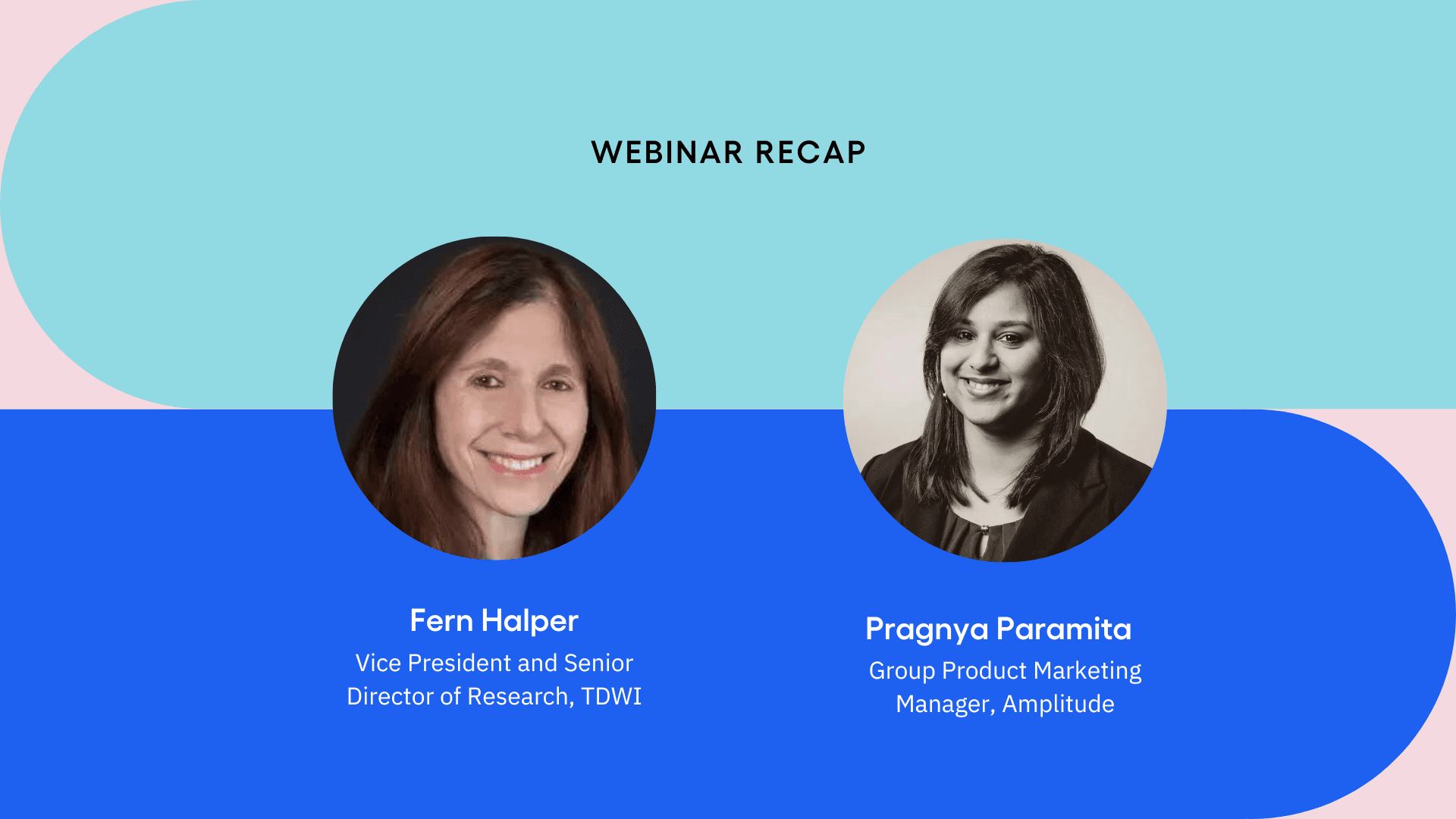
On April 27, 2023, I participated in a TDWI webinar focusing on data democratization alongside Fern Halper, vice president and senior director of TDWI research for advanced analytics. The webinar was hosted by Andrew Miller, manager of client services at TDWI.
Key topics
- How data democratization helps organizations make better decisions, enables cross-team collaboration, and empowers individuals
- The role of leadership, tools, and data literacy in data democratization
- How to measure the impact of data democratization to create a virtuous circle
- How Amplitude supports data democratization
- How to avoid data chaos and loss of control
Watch the full webinar: Five Critical Plays for Data Democratization.
The following are my key takeaways from the webinar. They’ll help you learn more about data democratization, how it can assist your organization in making better decisions, and how Amplitude allows you to share accurate data insights across your organization.
Benefits of data democratization
Fern began her presentation by explaining that while many organizations are starting to activate their data, the process is difficult because, in most cases, their data isn't accessible. 2023 research by TDWI shows that many organizations are aware of the problem and recognize the need to democratize data. Self-serve analytics is the top priority for businesses surveyed by TDWI, even ahead of machine learning.
Make better decisions
Fern explained that data democratization allows businesses to make informed decisions, which can result in better decision-making and outcomes. When teams don’t have to rely on the IT or data department to get insights, they can access information on their own time and respond quickly to data insights.
Business analytics users such as marketers might need to do exploratory analysis in the middle of a campaign. In that situation, Fern explained that marketers “can’t really wait” to get the answers to their questions. With democratized analytics, those users can access the insights they need when they need them.
Improve collaboration
Another benefit of data democratization is that it leads to better collaboration and teamwork across the organization. Fern explained that, in TDWI research, respondents often cite how important it is that teams understand wider business objectives. That central understanding is a top organizational best practice for success.
If all employees have access to the same data, it can create a shared understanding of the organization’s goals and objectives. When all teams—including non-technical teams—are on the same page about what’s happening in an organization and where it’s headed, collaborating and responding to changing conditions is easier.
Grow a culture of learning
The third benefit Fern shared was that data democratization also helps foster a culture of learning. On the business side, easy-to-use analytics tools help teams like sales and marketing to do their own analysis.
On the IT side, self-serve analytics on user behavior data means analysts don’t need to spend time trapped answering every business question. Instead, they can upskill and train on new approaches, for example, developing machine learning models.
In both cases, democratization helps employees feel more engaged and empowered, leading to higher job satisfaction.
Five critical plays for data democratization
After discussing the benefits of data democratization, Fern talked through five key components for democratizing data in an organization.
1. Empower the organization
According to Fern, empowerment starts are the top; organizations need a data champion in the C-suite.
TDWI recently ran a survey that asked respondents to self-identify as successful or not in terms of analytics. Those who were successful were more likely to have a committed analytics leader than those who were unsuccessful.
Fern explained that the analytics champion needs to “walk the walk.” They should ensure an analytics strategy is in place and provide the funding for it, including funding resources to help business users succeed, like data literacy programs.
The data champion must also lead by example to encourage the rest of the organization to become fluent in analytics. One way Fern has seen this is when executives use analytics in company-wide meetings and spotlight groups doing good work with analytics.
2. Put the correct data infrastructure in place
Infrastructure is another key component. For data democratization to work, people need to trust the data. Fern explained that TDWI research often shows that the right data platform is a critical element for analytics. The right platform helps build trust in data because it serves up high-quality data that is well-governed and accessible.
Businesses that are successful with analytics typically use cloud data platforms or a unified architecture that includes both cloud and on-premises platforms. Cloud platforms allow organizations to handle high volumes of diverse data and centralize it so it can be consistent, high quality, and trustworthy.
3. Provide the right tools for the right teams
Fern also explained the third play for data democratization is giving the right tools to the right teams. In other words, teams need tools that are easy to use and tailored to their function.
For example, marketing teams want to better understand customer journeys. In contrast, product teams might be more interested in understanding how people use the product and what leads to retention or churn. Both teams need tools to access these insights, bring different customer data sets together, create reports, visualize data, and explore data sets.
Fern noted that these tools may have machine learning capabilities enabling teams to do advanced analytics like predicting future behaviors or personalizing customer experiences.
4. Ensure data literacy is part of the plan
Part of giving people data access is ensuring they know how to use it. Fern defined data literacy as “how well an organization understands data and analytics and can effectively interact and communicate with the analytics to achieve results.” This includes technical factors, such as the ability to use certain tools, and non-technical factors, like critical thinking and being able to interpret the output of analytics.
Organizations that self-identify as successful with analytics are also likely to agree that data literacy is a priority in their organization. Fern has seen successful organizations create data literacy enablement teams responsible for providing data training for different personas. Those teams determine what different roles need in terms of training, devise a training strategy, execute that strategy, and then monitor and measure progress.
In some cases, the data literacy enablement team may deliver the training themselves, or else they might outsource it. For instance, they might send teams to vendor-sponsored training for a specific tool or outsource generalized training to an organization like TDWI.
5. Measure impact
TDWI research has found that organizations that are successful with analytics measure the impact. Fern emphasized that it’s important to measure impact and “measure it the right way” by tying impact to a business objective. Demonstrating the success of democratized analytics in a business sense builds a virtuous cycle: People see the tools are working, so they get on board with data.
For instance, some businesses that want to measure how well they’re democratizing analytics use the adoption of a solution as a metric for success. However, that isn’t a good metric. Many people might be using a tool, but that doesn’t mean it gives them the answers they need, explained Fern.
Read more in the TDWI playbook: Five Critical Plays for Data Democratization.
How Amplitude supports data democratization
After Fern’s initial presentation, I stepped in to explain how Amplitude supports organizations on their path to data democratization.
Remove the SQL bottleneck
Many businesses struggle to pull data insights because customer data lives in many different places. When a small group of analysts is responsible for making that data accessible, it’s difficult to scale access to data insights.
Some companies that use Amplitude have as many as two thousand users. Imagine if that number of data requests had to pass through a single data team. Amplitude’s ease of use means everyone in the organization can access data without relying on analysts or learning how to run SQL queries.
Gain insights beyond the first question
Once you get the answer to an initial data question, the insight gained usually sparks more questions. For example, you might start by wanting to know the number of loyal customers you have. However, once you've found that number, it raises questions like:
- How does a loyal customer look compared to a recently acquired customer coming to us for the first time?
- What is the impact of investing all this time and effort in increasing my customer acquisition efforts?
- Will this new campaign bring in the right kind of users I want to grow, nurture, and increase in lifetime value?
That’s where Amplitude comes in. We help customers expand access to data so they can run exploratory analyses and find the answers they need to drive business outcomes.
Get an end-to-end understanding of your customers
The customer’s experience of a product doesn’t end when a user joins the application. Businesses need to track how users get into the product, how frequently they use it, and whether they’re getting consistent value out of it.
With Amplitude, you get more than that initial insight into user acquisition and who’s staying and leaving. We give teams an end-to-end understanding of the digital journey with proactive and predictive insights into who will stay and who will jump out of your platform.
Q&A
After our presentations, we answered some questions from the webinar audience.
How can you ensure that data democratization doesn’t result in data chaos or loss of control?
Fern explained that to avoid chaos, you must balance data governance and freedom, so business users can use data as they want; “it’s a balancing act,” she said. Some organizations have a dedicated chief data officer responsible for coordinating governance across different teams.
Amplitude customers tend to manage data governance in three different ways. Some organizations set up governance in Amplitude and decide on company wide-definitions of different metrics, which gives everyone a common understanding of what they’re tracking. Others use Amplitude as a CDP, so their entire data pipelines are created within Amplitude, giving them more control over how they organize customer data.
We’ve also seen larger digital native organizations use a data warehouse or lake house as their source of truth for the data that comes into Amplitude. We have data teams who control the data warehouse, so there isn’t a data loss or data drift between those two applications.
Does Amplitude work with Snowflake?
Snowflake is one of our key strategic partners. Our bidirectional integration enables customers to pipe data into Amplitude from Snowflake and take insights generated in Amplitude back into Snowflake. But we also support working with Snowflake data in a variety of ETL and zero ETL ways. Check those out on our integrations page.
How does Amplitude support advanced data science and machine learning initiatives within organizations?
An example from one of our customers answers this best. Restaurant Brands International (RBI)—the parent company of Popeyes, Tim Hortons, and Burger King—collects behavioral data and analyzes it with Amplitude to understand what drives higher average order values. For example, what makes someone add an extra burger or fries to their order, and what kind of users add those things?
Then they take that behavioral data back into their Snowflake data warehouse to build a machine-learning model. Based on the app behavior data, the machine learning model can now predict whether you’re likely to take extra fries, a soda, or a milkshake. In other words, it knows what it should offer you. Deploying the ML model has increased RBI's drive-through revenue by millions of dollars.
Watch the full webinar or download the TDWI playbook to learn more about improving data democratization.

Pragnya Paramita
Former Group Product Marketing Manager, Amplitude
Pragnya is a former Group Product Marketing Manager at Amplitude. She led the go-to-market efforts for data management products. A graduate of Duke University's Fuqua School of Business, she is passionate about working at the intersection of business and technology and when time allows, cooking up a storm with cuisines from all over the world.
More from Pragnya


